FREE Sketch Order Tracking Icon: Scalable, Expressive Vector Assets for Modern Interfaces
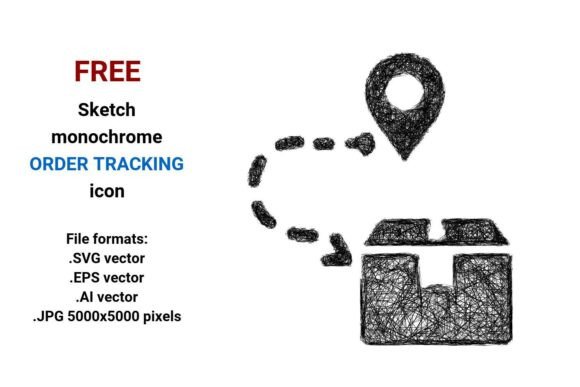
Designing intuitive, human-centered digital experiences often hinges on subtle yet powerful visual cues — and few elements communicate action and reassurance as effectively as a well-crafted order tracking icon. The FREE Sketch Order Tracking Icon stands apart not just for its accessibility, but for how it bridges functional clarity with expressive authenticity. Unlike sterile, over-polished icons, this set embraces the warmth of hand-drawn aesthetics while delivering professional-grade technical precision. Available in four versatile file formats — .SVG vector, .EPS vector, .AI vector, and a high-resolution .JPG (5000x5000 pixels) — it empowers designers, developers, educators, and small business owners to implement track order functionality across platforms without compromise.
Why Vector Quality Matters for Order Tracking Icons
A vector image is fundamentally different from raster graphics: it’s built from mathematical equations that define points, lines, curves, and shapes — not fixed pixels. This means the FREE sketch black and white order tracking icon retains razor-sharp clarity whether scaled to 24px in a mobile app header or enlarged to 3000px for an interactive retail dashboard. For delivery and tracking interfaces — where users glance quickly under time-sensitive conditions — legibility at any size isn’t optional; it’s essential. Raster icons blur or pixelate when resized; vector icons like these remain crisp, consistent, and production-ready.
This technical resilience supports real-world workflows: a UX designer can drop the .SVG vector directly into Figma or Adobe XD for prototyping, a front-end developer can embed it inline for responsive SVG scaling, and a print designer can open the .EPS vector or .AI vector in Illustrator to adjust stroke weight, color, or composition — all without quality loss. Even the .JPG 5000x5000 pixels version serves a distinct purpose: high-fidelity mockups, presentation decks, or legacy CMS environments that don’t support SVG natively.
Sketch Aesthetics Meet Functional Precision
The “sketch” in FREE Sketch Order Tracking Icon isn’t decorative — it’s intentional design language. These icons use sketchy line icon strokes, subtle rough texture hints, and organic curvature to evoke approachability and human intention. They avoid cold minimalism without sacrificing clarity: the outline remains clean, the stroke weight is balanced, and the curved path of a delivery truck or package icon suggests motion and progress — reinforcing the core user goal: track order.
This doodle style icon approach resonates across audiences. Educators use handdrawn order tracking icon assets in classroom materials to soften complex logistics concepts. Startups building MVP dashboards choose modern sketch icon sets to signal agility and user empathy. Even enterprise teams integrate them into internal tools where rigid corporate iconography feels disconnected from actual workflows. The pen drawn icon quality signals that systems serve people — not the other way around.
Practical Applications Across User Journeys
Where does an order tracking button or track order icon actually live — and why does this specific sketch variant excel there?
- E-commerce checkouts: Placed beside “Order Confirmed” messages, the icon visually anchors the next step. Its isolated, editable nature lets brands tint the sketch stroke to match their palette without redrawing — supporting brand consistency while preserving handcrafted nuance.
- Delivery partner portals: Dispatch teams viewing real-time tracking maps benefit from icons that stand out against data-dense backgrounds. The black and white order tracking icon’s high contrast ensures visibility even on low-brightness tablets used in warehouses or vehicles.
- Customer service dashboards: Agents resolving delivery inquiries need instant visual recognition. A sketch line icon of a package with a checkmark or clock conveys status faster than text alone — especially across multilingual support environments.
- Educational simulations: Logistics courses use these icons in interactive supply chain models. Because they’re editable and vector-based, instructors can annotate paths, layer timelines, or isolate components for teaching moments — turning static assets into dynamic learning tools.
Design Flexibility Without Technical Debt
“Editable” isn’t marketing jargon here — it’s baked into the file architecture. The .AI vector and .EPS vector files preserve layers, groups, and anchor points. Need to separate a truck silhouette from its trail? Adjust the scribble icon rhythm to emphasize urgency? Replace a generic box with a custom product shape? All possible — no reverse engineering required. The .SVG vector version includes clean, semantic IDs and classes, making CSS-driven interactivity straightforward: hover states, animated path reveals, or dynamic color shifts based on tracking status (e.g., gray → blue → green as an order moves from “shipped” to “out for delivery” to “delivered”).
This flexibility matters for sustainability. Teams avoiding redundant asset creation reduce design debt. A single FREE sketch order tracking icon set can serve web, iOS, Android, email templates, printed shipping labels, and augmented reality packaging previews — because vector scalability and editable structure eliminate the need for multiple raster versions.
Accessibility and Inclusivity by Design
Sketch-style icons are sometimes mischaracterized as “less serious” — but when grounded in strong information hierarchy and contrast, they enhance accessibility. The FREE sketch black and white order tracking icon meets WCAG 2.1 AA contrast ratios in its default state. Its minimal detail avoids visual noise that can overwhelm users with cognitive differences, while its clear artistic metaphor (a stylized map pin + package + arrow) supports comprehension across literacy levels and languages.
Crucially, these icons work *with* assistive technologies — not against them. When implemented correctly (e.g., using aria-label="Track your order" with the SVG), they provide both visual and programmatic meaning. The interface becomes more inclusive not through complexity, but through thoughtful reduction: every curve, every stroke, every negative space serves the user’s need to understand where their order is — right now.
Integration Considerations for Real Projects
Adopting these icons requires attention to context, not just compatibility. For example:
- Consistency: If your interface uses flat, geometric icons elsewhere, introducing a sketchy line icon may create visual dissonance. Consider adapting the stroke style across your full icon set — or use the sketch variant selectively for high-empathy touchpoints (like post-purchase status pages).
- Performance: While .SVG vector files are lightweight, embedding large numbers of inline SVGs can impact render speed. For scalable systems, use
references to a single sprite sheet or lazy-load icons below the fold. - Licensing: Though labeled “FREE,” always verify usage rights. This set permits commercial use, modification, and redistribution — but attribution isn’t required. That freedom enables everything from open-source logistics plugins to white-labeled SaaS dashboards.
Beyond Decoration: Icons as Trust Signals
In an era of rising cart abandonment and delivery anxiety, the track order action is deeply emotional. Users aren’t just seeking location data — they’re seeking reassurance, control, and transparency. A freehand icon that feels deliberately crafted — not algorithmically generated — subtly communicates care and intentionality. It tells customers: “We didn’t automate this step away. We designed it for you.”
This psychological resonance extends to B2B contexts too. When a logistics platform licenses these icons for its client-facing portal, it signals operational maturity *and* user-centricity — differentiating itself from competitors relying on generic, overused clipart. The illustration quality transforms a functional component into a quiet brand statement.
Getting Started Responsibly
Downloading and deploying the FREE Sketch Order Tracking Icon is simple — but maximizing its impact requires intention. Begin by auditing where users currently struggle to track order or interpret delivery status. Is the existing icon ambiguous? Hidden behind menus? Inconsistent across devices? Use those pain points as your implementation compass.
Then, leverage the format strengths strategically: start with .SVG vector for web interfaces, use .AI vector to customize stroke dynamics for dark mode, and deploy the .JPG 5000x5000 pixels version only where vector support is absent — never as a substitute for scalable assets. Test with real users: does the sketch order tracking icon improve task success rate? Does its rough texture feel inviting or distracting? Iterate based on evidence, not assumptions.
Ultimately, this isn’t just about acquiring free assets. It’s about recognizing that even the smallest interface element — a track order icon, a delivery indicator, a tracking button — carries weight. The FREE sketch black and white order tracking icon, in all its vector fidelity and expressive honesty, offers a rare convergence: technical excellence, human-centered design, and practical utility — all in one downloadable set.