FREE Sketch Moose Icon: A Scalable, Expressive Asset for Modern Design Systems
In today’s fast-evolving digital landscape—where authenticity, speed, and visual cohesion define competitive advantage—the FREE Sketch Moose Icon has emerged not as a novelty, but as a quietly strategic resource. Designed in black and white with deliberate hand-drawn character, this versatile asset delivers more than aesthetic charm: it embodies a growing shift toward expressive yet functional design elements that retain technical precision without sacrificing human warmth.
What Is the FREE Sketch Moose Icon—and Why Does It Matter?
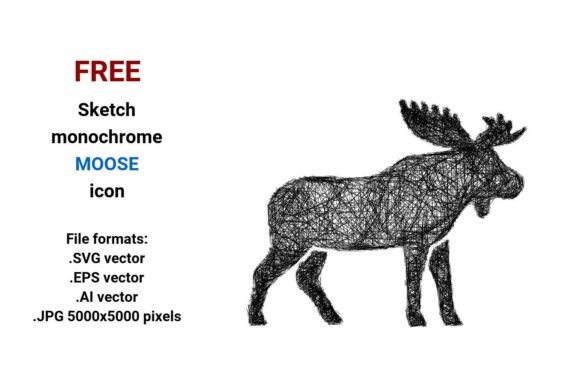
The FREE Sketch Moose Icon is a meticulously crafted, royalty-free vector illustration of a moose rendered in a relaxed, sketch-style line art aesthetic. Unlike photorealistic or overly polished icons, it embraces subtle imperfections—slight curvature in strokes, organic spacing, and confident, uneven line weight—that evoke hand-drawn authenticity while remaining rigorously scalable and production-ready.
It’s available in four industry-standard file formats: .SVG vector, .EPS vector, .AI vector, and a high-resolution .JPG (5000×5000 pixels). This multi-format flexibility ensures seamless integration across tools and workflows—from Figma and Adobe XD (via SVG import) to print collateral and marketing assets (via EPS or AI), all the way to social media banners or documentation (via the crisp JPG variant).
Crucially, “sketch” here isn’t shorthand for unfinished—it signals intentionality. The icon balances roughness and rigor: each curve is mathematically defined (enabling infinite scaling), yet every stroke feels deliberately placed—like a designer’s confident pencil mark captured in vector form. That duality makes it uniquely suited for contexts where brand voice, usability, and technical fidelity must coexist.
Aligning With Design Evolution: From Generic to Expressive UI
Design systems are no longer just about consistency—they’re about character. As platforms mature and interfaces become increasingly standardized, users subconsciously gravitate toward visual cues that feel human, intentional, and context-aware. A sketched moose icon may seem niche at first glance—but its resonance lies in how it mirrors broader trends:
- UX Humanization: In dashboard interfaces and SaaS applications, illustrative icons like the sketch moose button soften transactional interactions. A study by NN/g found that users perceive interfaces with expressive, non-generic icons as more trustworthy and easier to learn—even when functionality remains identical.
- Brand Differentiation: When competitors rely on flat, geometric icons, a handdrawn moose icon becomes a quiet signature—especially for outdoor brands, conservation NGOs, education platforms, or regional tourism initiatives centered around elk moose habitats.
- Workflow Efficiency: Designers and developers increasingly demand assets that work *immediately*: editable vectors (.AI/.EPS), responsive web-ready files (.SVG), and pixel-perfect exports (.JPG). The FREE Sketch Moose Icon meets all three—eliminating conversion steps, reducing QA friction, and accelerating prototyping cycles.
This isn’t about replacing system icons—it’s about expanding the expressive palette. A sketch moose symbol might anchor an onboarding flow for a wildlife tracking app, serve as a playful navigation label in an educational platform about North American wild animal ecosystems, or function as a thematic toggle in a sustainability dashboard. Its strength lies in contextual adaptability—not universal application.
Why Professionals Are Turning to Sketch-Style Vector Icons Now
Three converging shifts explain rising interest in resources like the FREE Sketch Moose Icon:
1. The Rise of “Intentional Imperfection” in Visual Language
After years of ultra-minimalist, borderless UIs, designers are reintroducing texture, gesture, and variation—not as decoration, but as meaning. A rough sketch moose icon communicates approachability and curiosity. It subtly signals that the product values exploration over rigidity—a powerful alignment for edtech, creative tools, or community-driven platforms.
2. Demand for Cross-Platform Editability Without Compromise
Freelancers building client dashboards need to tweak stroke weight or adjust proportions in Illustrator; marketers embedding assets into Canva or WordPress need lightweight, responsive SVGs; print designers require CMYK-ready EPS files. The FREE Sketch Moose Icon satisfies all these needs natively—no third-party converters, no quality loss, no licensing ambiguity. That reliability translates directly into billable hours saved and fewer revision rounds.
3. Growing Emphasis on Thematic Cohesion Over Generic Symbolism
“Moose” isn’t just an animal—it’s a cultural signifier: resilience, northern wilderness, quiet strength. For businesses rooted in place-based identity (e.g., Maine-based outfitters, Canadian eco-tourism startups, or Scandinavian design studios), using a vector moose icon adds semantic depth. It transforms a functional element—a moose button or dashboard sketch icon—into a narrative touchpoint. That’s especially valuable in markets saturated with interchangeable “generic nature” icons.
Practical Applications Across Roles
How do real professionals integrate this asset? Here’s how it functions beyond decoration:
- For UX Designers: Use the .SVG version as a custom interactive element in Figma prototypes—applying hover states, transitions, or accessibility labels without raster degradation. Its outline and line art structure ensure clarity even at 16px.
- For Marketers: Embed the .JPG variant into email headers or LinkedIn carousels targeting outdoor enthusiasts. Its high resolution (5000×5000 px) allows clean cropping for thumbnails, banners, and print-ready flyers—all while retaining the authentic black white sketch tone.
- For Developers: Import the .SVG directly into React components or CSS background properties. Because it’s pure vector markup, it scales flawlessly on Retina displays and supports dynamic theming (e.g., changing stroke color via CSS variables).
- For Educators & Content Creators: Annotate the .AI file to build layered learning visuals—adding callouts, arrows, or habitat overlays while preserving original sketch integrity. Ideal for K–12 science modules or university ecology presentations.
Technical Strength Meets Creative Flexibility
At its core, the FREE Sketch Moose Icon exemplifies what modern digital assets must deliver: technical robustness paired with creative latitude. Its scalable sketch icon architecture means it works identically whether displayed on a smartwatch notification or a 40-foot conference backdrop. Its editable sketch icon nature allows teams to align it precisely with brand guidelines—adjusting contrast, simplifying paths, or integrating it into larger illustrated scenes—without losing fidelity.
And because it’s optimized for ux sketch icon use cases—think status indicators, empty-state illustrations, or feature toggles—it avoids common pitfalls of hand-drawn assets: inconsistent stroke alignment, unbalanced negative space, or poor legibility at small sizes. Every curve is purpose-built for interface fluency.
Looking Ahead: Beyond the Icon
The FREE Sketch Moose Icon is more than a download—it’s a signal of maturing design priorities. As AI accelerates asset generation, human-crafted, contextually grounded resources gain renewed value. They offer nuance algorithms still struggle to replicate: cultural resonance, tonal subtlety, and intentional imperfection.
For professionals building products, campaigns, or communities tied to the natural world—or simply seeking design elements with distinctive voice—the sketch moose icon represents a rare convergence: free, functional, and meaningfully expressive. Whether you’re designing a conservation dashboard, launching an outdoor apparel line, or teaching students about wild animal biodiversity, this asset doesn’t just fill a placeholder—it reinforces intent.
As design continues shifting from “what works” to “what resonates,” resources like the FREE Sketch Moose Icon won’t just remain relevant—they’ll become essential infrastructure for human-centered digital experiences.