FREE Sketch Lime Icon: Scalable, Playful, and Purpose-Built for Modern Digital Interfaces
In today’s fast-evolving digital landscape—where clarity, authenticity, and visual consistency drive user trust—designers, developers, and product teams are rethinking how icons communicate. Not just as functional signifiers, but as subtle expressions of brand voice, tone, and intention. Enter the FREE Sketch Lime Icon: a hand-drawn, scalable vector resource that merges organic expressiveness with technical precision. More than a decorative element, it’s a responsive design asset engineered for real-world workflows—from dashboard UIs and mobile apps to marketing landing pages and creative pitch decks.
What Is the FREE Sketch Lime Icon—and Why Does Its Format Matter?
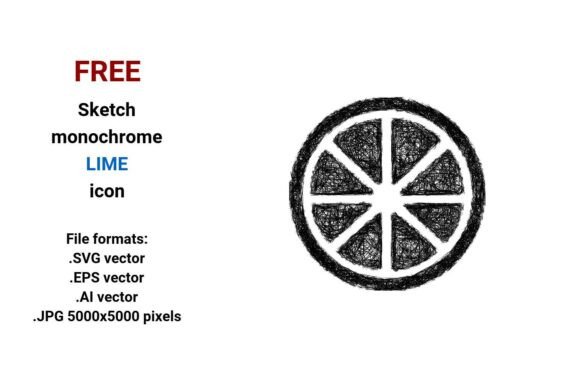
The FREE Sketch Lime Icon is a meticulously crafted digital representation of a lime—a vibrant, green citrus fruit—rendered in an intentional sketch style: loose yet controlled, expressive yet legible. Unlike photorealistic or overly polished icons, this version embraces hand-drawn sketch, scribble, and line art sketch sensibilities—evoking approachability, creativity, and human-centered design.
Crucially, it ships in four production-ready file formats:
- .SVG vector — Optimized for web use: lightweight, responsive, and natively supported across all modern browsers and frameworks (React, Vue, Figma, Webflow).
- .EPS vector — Industry-standard for print, large-format signage, and legacy Adobe workflows.
- .AI vector — Fully editable in Adobe Illustrator, with layered paths, grouped elements, and non-destructive stroke settings.
- .JPG (5000×5000 pixels) — High-resolution raster output ideal for presentations, social media banners, or documentation where vector embedding isn’t possible.
This multi-format delivery reflects a broader shift in digital asset expectations: creators no longer want “one-size-fits-all” graphics. They need context-aware assets—scalable for code, precise for print, editable for iteration, and resolution-robust for cross-platform reuse. The FREE Sketch Lime Icon answers that need without compromise.
More Than a Fruit: How Green Lime and Citrus Symbolism Align With Design Trends
A lime isn’t just a fruit; it’s a cultural and psychological shorthand. Its bright green hue signals freshness, energy, and vitality. In interface design, the green lime functions as both a literal and metaphorical anchor—suggesting sustainability, growth, acidity (as in “sharp feedback”), or even playful disruption. This resonance makes it especially valuable in sectors like health tech, eco-conscious brands, food & beverage SaaS, and edtech platforms where warmth and clarity must coexist.
Consider how citrus-themed icons are appearing beyond food apps: a fintech dashboard uses a sketch lime button to highlight “refresh balance”; a climate analytics tool deploys a black and white lime icon as a minimalist toggle for carbon impact visualization; a wellness app embeds a green lime vector into its habit-tracking flow—not as decoration, but as a consistent, emotionally resonant motif.
This reflects a larger industry movement: away from sterile, over-engineered UI components and toward human-scaled symbolism. Users respond not to perfection—but to cues that feel intentional, relatable, and grounded. A playful sketch icon doesn’t dilute professionalism; it deepens engagement by signaling that the interface was made *by people, for people*.
Why Designers Are Choosing Sketch-Style Icons Over Flat or Glyph Alternatives
Flat icons dominated the 2010s. Glyphs followed, offering typographic efficiency. Today, designers are reaching for something different: sketchy line icons and outline sketch illustrations that retain character at any scale. Why?
- Differentiation in saturated markets: When dozens of tools offer near-identical “settings” or “home” glyphs, a sketch pictogram like the FREE Sketch Lime Icon becomes a quiet differentiator—memorable without being loud.
- UX alignment with voice and tone: A fintech startup targeting Gen Z entrepreneurs might pair clean sans-serif typography with freehand sketch icons to convey agility and anti-corporate energy—without sacrificing usability.
- Effortless scalability and theming: Because it’s built as a true vector image—defined by mathematical points, lines, and curves—the FREE Sketch Lime Icon scales flawlessly from a 16px toolbar item to a 2000px hero section background. No pixelation. No quality loss. Just fidelity, always.
And unlike raster-only assets, every vector format (.SVG, .EPS, .AI) supports color customization, stroke adjustment, and dynamic theming—essential for dark mode support, accessibility contrast compliance, or seasonal branding updates.
Workflow Integration: From Concept to Code—Without Friction
For professionals juggling tight deadlines and cross-functional handoffs, compatibility isn’t optional—it’s foundational. The FREE Sketch Lime Icon bridges gaps between disciplines:
- Product managers embed the .SVG directly into Figma prototypes, then export it as React components using automated plugins—no developer handoff delay.
- Marketing teams drop the .JPG (5000×5000) into Canva or PowerPoint for investor decks, ensuring crisp visuals on any projector or screen size.
- Frontend engineers import the .SVG as inline code or via
- Brand designers open the .AI file to adjust line weight, add subtle hatch textures, or integrate the lime into a custom icon system—all while preserving vector integrity.
This interoperability reflects a maturing design ecosystem—one where assets aren’t siloed by tool or role, but designed for reuse, remixing, and rapid iteration. The FREE Sketch Lime Icon doesn’t ask users to adapt their process; it adapts to theirs.
Looking Ahead: Where Sketch Icons Fit Into the Future of Interface Design
As AI accelerates prototyping and generative design gains traction, the value of intentionally crafted, human-made assets grows—not diminishes. Algorithms can replicate shapes, but they struggle with nuance: the slight taper of a sketch stroke, the asymmetry that conveys spontaneity, the balance between line art minimalism and expressive warmth. That’s why resources like the FREE Sketch Lime Icon remain indispensable.
They serve as grounding elements in increasingly abstract interfaces—reminders that behind every dashboard, app, or platform is a team making deliberate choices about how users should *feel*, not just what they should *do*. Whether used as a lime button to trigger a key action, a citrus vector in a data visualization legend, or a creative concept anchor in a brand guideline, its function extends beyond utility into emotional architecture.
Moreover, its black and white foundation ensures accessibility-first flexibility: designers can apply WCAG-compliant contrast ratios, animate strokes for micro-interactions, or layer it over gradients without visual conflict. It’s not just a graphic—it’s a design system element.
Final Thought: Intentionality Starts With the Asset
In a world of infinite templates and AI-generated mockups, choosing a single icon—like the FREE Sketch Lime Icon—is an act of curation. It signals attention to detail, respect for context, and commitment to craft. For entrepreneurs launching MVPs, freelancers building client portfolios, or marketers refreshing campaign assets, it delivers more than visual flair: it delivers strategic coherence.
Whether you’re designing a nutrition tracker, a sustainable packaging platform, or an internal analytics dashboard, the green lime offers a versatile, emotionally intelligent touchpoint—rooted in nature, refined through vector precision, and ready for whatever comes next.
Download it. Scale it. Customize it. Embed it. Let the FREE Sketch Lime Icon do more than represent a fruit—it can embody your intent.