Boy Dad Camouflage Badge PNG Vector SVG: A Tactical Asset for Purpose-Driven Design Projects
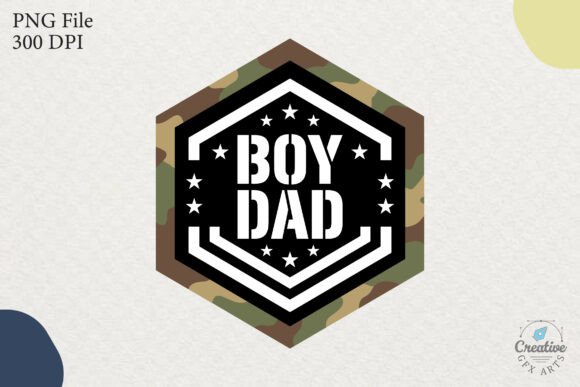
When you're developing branded apparel, planning a Father’s Day campaign, or producing custom merchandise for a community of proud dads, asset readiness directly impacts execution speed and output quality. The Boy Dad Camouflage Badge PNG Vector SVG isn’t just another graphic—it’s a production-ready component engineered for integration across design, print, and digital workflows. Its structure—hexagonal shape, camouflage border, black core, white outline, and centered “BOY DAD” text with star accents—was built with scalability, contrast, and context in mind. That means less time adjusting files and more time deploying consistent, high-impact visuals.
How This Badge Fits Into Real Creative Workflows
This badge functions as both a standalone identifier and a modular element within larger systems. For example, a small-batch apparel brand might use the SVG version to auto-generate mockups across 20+ t-shirt colors in Adobe Illustrator or Figma—thanks to its vector nature and transparent background. A freelance designer building a client’s “Proud Dad” social media kit can drop the PNG into Canva templates without resizing artifacts or background cleanup. Meanwhile, a print-on-demand store owner uses the 300 DPI JPG for product listing thumbnails and the EPS for direct upload to their DTG printer’s RIP software—ensuring crisp edges at any size.
The key is recognizing where the badge sits in your process: it’s rarely the starting point, but often the linchpin that bridges concept and delivery. Before finalizing a Father’s Day email series, you’d embed the badge in hero banners, email footers, and downloadable gift guides. During a sublimation run for dad-themed tumblers, you’d import the SVG into Silhouette Studio or Cricut Design Space, scale it precisely to fit curved surfaces, and batch-export cutting paths. After launch, the same file becomes part of your brand asset library—tagged, named consistently (e.g., boy-dad-badge-camo-hex-2024-v1.svg), and stored alongside usage guidelines.
Compatibility and Integration Across Tools
Because it ships in four formats—EPS, SVG, JPG, and PNG—this badge adapts to different stages and platforms without requiring conversion or compromise. EPS ensures backward compatibility with legacy prepress systems used by commercial printers. SVG supports responsive web use: you can embed it inline in HTML for sharp rendering on mobile devices or animate its stars via CSS without losing fidelity. PNG delivers immediate usability for social posts, email graphics, or quick sticker proofs—especially valuable when transparency matters (e.g., overlaying the badge onto a camo-patterned hoodie photo). JPG serves as the universal fallback for platforms that don’t accept vector uploads, like some e-commerce CMS dashboards or basic email clients.
Importantly, all versions maintain identical proportions and visual hierarchy. That consistency reduces QA overhead: if the text reads clearly at 24px in the SVG preview, it will render cleanly at 240px on a wall poster. No need to recheck kerning, stroke weight, or star alignment across formats—those decisions were locked in during creation.
Practical Implementation Tips for Different Roles
- For marketers: Use the transparent PNG to create layered Instagram Stories—place it over lifestyle photos of dads and sons, then add motion blur or subtle parallax for engagement. Save variants with light/dark mode backgrounds to ensure readability across devices.
- For educators or nonprofit coordinators: Import the SVG into Google Slides or PowerPoint to build presentation decks for parenting workshops. Duplicate the badge, recolor the inner black shape to match your organization’s palette, and repurpose it as a section divider or achievement icon—no redesign needed.
- For small business owners: Load the EPS into your embroidery digitizing software (e.g., Wilcom or Pulse) to generate stitch files for patches. Because the hexagon has clean angles and minimal fine detail, it converts reliably—even at 2.5 inches wide—reducing test sew-outs.
- For content creators: Add the badge to your video intro sequence using the PNG with alpha channel. Animate it rotating slightly on entry, then lock it into the lower third during voiceover segments. Its high-contrast styling ensures visibility even against busy backgrounds.
Quality Control and Long-Term Usability
Because this badge was designed with production constraints in mind—not just aesthetics—it avoids common pitfalls that derail reuse. There are no embedded raster effects, no ungrouped layers, no stray anchor points. The camouflage border is built from vector patterns, not bitmap fills, so it scales infinitely without pixelation. The white outline isn’t a stroke applied in post—it’s part of the base shape, ensuring reliable knockout behavior when printed over dark fabrics or layered in multi-color screen prints.
That attention to construction translates directly to long-term efficiency. You won’t need to re-trace, re-outline, or re-export every time platform requirements shift. Store the original ZIP archive in a dedicated “Brand Assets > Dad Themes” folder, and create a simple internal document listing each format’s best use case (e.g., “Use SVG for web, PNG for social, EPS for embroidery, JPG for CMS uploads”). Update that doc only if new versions are released—don’t treat it as a living document, but as a stable reference.
Strategic Placement Within Broader Projects
Think of the Boy Dad Camouflage Badge PNG Vector SVG not as decoration, but as a functional identifier—similar to how a logo signals brand ownership or a safety icon communicates protocol. In a Father’s Day gift bundle, it appears on the box seal, the thank-you card, and the digital receipt. In a podcast episode about fatherhood, it becomes the chapter marker icon and the thumbnail overlay. On a tactical gear retailer’s site, it tags product categories (“Boy Dad Approved”) and filters search results—linking back to a curated collection of compatible items.
Its military-inspired styling isn’t just aesthetic; it signals values—discipline, protection, reliability—without needing explanatory text. That makes it especially effective in environments where space is limited (like app icons or packaging stamps) or where audience resonance matters deeply (e.g., veteran dad communities or outdoor parenting groups).
Final Considerations for Smooth Integration
Before deploying, verify color mode: the included files are RGB for digital use and CMYK-ready for print (EPS and JPG include embedded profiles). If you’re working in Pantone-based branding, sample the black core and white outline against your swatches—most users find them align well with Black C and White U, but always soft-proof on target substrates. Also, note that the stars are grouped as a single compound path, not individual shapes—this preserves alignment during scaling and simplifies editing if you later need to adjust spacing or count.
Finally, treat this badge as a node—not an endpoint. Link it to related assets: pair it with complementary “Boy Dad” typography sets, coordinate it with matching camo pattern tiles, or align its hexagonal geometry with other badges in your suite (e.g., “Girl Dad,” “Proud Grandpa”). Consistency compounds value: one well-integrated badge builds trust; a system of aligned elements builds authority.