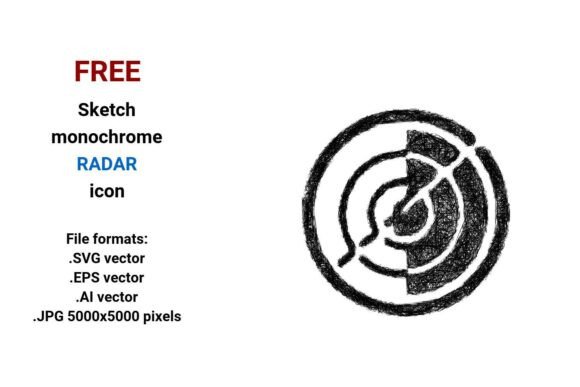
FREE Sketch Radar Icon: A Versatile Vector Asset for Navigation, Design, and Communication
When visual clarity meets functional precision—especially in maritime, aviation, or interface design—the FREE Sketch Radar Icon stands out not just as decoration, but as a purpose-built communication tool. Unlike photorealistic or overly stylized radar graphics, this icon embraces a deliberate handdrawn radar icon aesthetic: clean, monochrome, and rooted in line art sketch principles. Its value lies not only in its visual character but in its technical flexibility—delivered across four editable file formats: .SVG vector, .EPS vector, .AI vector, and a high-resolution .JPG (5000×5000 pixels). This combination makes it uniquely suited for contexts where scalability, adaptability, and semantic resonance matter—from marine navigation dashboards to academic presentations on sensor systems.
Why Vector Format Matters for Radar Icons
A vector image is fundamentally different from raster-based graphics. It’s constructed from mathematical equations that define points, lines, curves, and shapes—not fixed pixels. That means whether you’re embedding the FREE sketch black and white radar icon into a tiny mobile app button or printing it at 3 meters wide on a maritime training poster, it remains razor-sharp. No pixelation. No quality loss. No need for multiple asset sizes.
This fidelity is critical for applications like marine radar interfaces, where legibility under variable lighting and motion conditions is non-negotiable. A vector-based radar button can be dynamically recolored via CSS or code to indicate active status, warning states, or system modes—something impossible with static JPGs. Similarly, designers using Adobe Illustrator or Figma can adjust stroke weight, curvature, or anchor points directly in the .AI or .SVG versions, preserving the sketchy icon feel while tailoring it precisely to brand guidelines.
Design Philosophy: Sketch Style Meets Technical Clarity
The FREE Sketch Radar Icon doesn’t simulate radar hardware—it communicates the *idea* of radar through minimal, intentional mark-making. Think of it as a line radar icon distilled to its essence: concentric arcs suggesting sweep rotation, a central dot representing the vessel or sensor origin, and subtle radial lines evoking directional scanning—all rendered in crisp black white sketch contrast.
This approach aligns with several modern design imperatives:
- Accessibility: High-contrast monochrome ensures readability for users with color vision deficiencies—essential in safety-critical environments like bridge navigation.
- Performance: Lightweight .SVG files load instantly, improving web and app responsiveness—valuable for real-time navigation dashboards or fleet management portals.
- Cognitive efficiency: The rough sketch icon style avoids visual noise. Studies in human-computer interaction show that simplified, outline-based symbols are recognized faster than detailed pictograms—particularly under time pressure or cognitive load.
It’s not “unfinished”—it’s deliberately sketch radar button—a design choice that signals conceptual clarity over literal representation. That’s why educators use it in physics lectures on wave propagation, and UX researchers include it in wireframes testing mental models of location-aware systems.
Real-World Applications Across Domains
The versatility of the FREE sketch black and white radar icon becomes evident when examining how diverse professionals integrate it into workflows:
Maritime & Nautical Use
In ship navigation software, this icon serves dual roles: as an interactive radar button toggling the radar overlay, and as a static marine radar icon in status bars or legend keys. Because it’s delivered in .EPS and .AI, naval architects can embed it directly into CAD documentation or compliance schematics—maintaining vector integrity alongside technical drawings. Its curved, sweeping geometry subtly reinforces the rotational nature of actual radar sweeps, supporting intuitive understanding.
Educational & Research Contexts
Researchers visualizing signal detection algorithms often pair the FREE Sketch Radar Icon with annotated flowcharts or simulation outputs. Its editable nature allows them to add dynamic overlays—like animated scan lines or target markers—without distorting base geometry. In university courses on remote sensing or autonomous systems, instructors use the .JPG (5000×5000) version for large-format classroom posters, ensuring crisp detail even when projected at 4K resolution.
Digital Product & Interface Design
For SaaS platforms offering vessel tracking or port logistics tools, this icon functions as both a button icon and a design element. Its minimal construction scales seamlessly across device breakpoints; its stroke-based rendering adapts elegantly to dark mode UIs. Unlike generic icons from stock libraries, its handdrawn quality conveys authenticity—important for brands emphasizing human-centered technology or artisanal craftsmanship in engineering.
E-Commerce & Marketing Assets
Manufacturers of marine electronics use the FREE sketch radar icon in product comparison tables, spec sheets, and explainer videos. Because it’s monochrome sketch icon, it integrates cleanly into branded templates without clashing colors. Its scribble-adjacent texture adds visual warmth to otherwise technical collateral—making complex topics like Doppler shift or pulse repetition frequency feel more approachable to buyers who aren’t radar engineers.
File Format Breakdown: Matching Format to Function
Each included format serves a distinct production need:
- .SVG vector: Ideal for websites, web apps, and responsive interfaces. Supports CSS manipulation, accessibility attributes (
aria-label), and animation (e.g., rotating sweep effect). Perfect for web developers implementing live navigation controls. - .EPS vector: Industry-standard for print workflows and legacy design suites. Ensures compatibility with prepress systems used by maritime publishers or certification bodies producing official manuals.
- .AI vector: Native Adobe Illustrator format—enables full editing: adjusting anchor points, applying gradients (if desired), combining with other assets, or exporting custom variants. Preferred by professional designers building cohesive icon sets for marine software UIs.
- .JPG (5000×5000 pixels): High-fidelity raster fallback. Used where vector support is unavailable—such as certain PDF generators, legacy CMS platforms, or embedded displays with limited rendering engines. Its resolution supports ultra-HD signage, trade show banners, or printed training materials without upscaling artifacts.
Implementation Best Practices
To maximize utility and maintain semantic integrity, consider these practical guidelines:
- Contextual labeling: Even minimalist icons benefit from text labels in navigation menus or toolbars—especially for audiences unfamiliar with radar symbology. Pair the FREE Sketch Radar Icon with “Radar View” or “Scan Mode” rather than relying solely on visual recognition.
- Consistent stroke behavior: If scaling the icon significantly in SVG, test stroke uniformity. Some renderers may scale strokes disproportionately—use
vector-effect="non-scaling-stroke"in SVG code to preserve hand-drawn thickness. - Color adaptation: While delivered in black-and-white, the vector files allow easy recoloring. For marine interfaces, consider navy blue (#0A2E5C) or safety orange (#FF6B35) for active states—colors with proven visibility against instrument panel backgrounds.
- Accessibility integration: When using the SVG in HTML, include descriptive
</code> and <code><desc></code> elements. Example: <code><title>Marine radar activation button
Beyond Decoration: The Symbolic Weight of Radar Imagery
Radar isn’t just a tool—it’s a cultural and technical symbol of vigilance, spatial awareness, and environmental perception. A simple icon like the FREE Sketch Radar Icon carries that symbolic weight. Its curved arcs suggest both the physical dome of a shipboard radar and the abstract “field of view” in data visualization. Its rough linework echoes field sketches made by navigators before digital charts—connecting past and present practices.
This resonance extends to non-maritime uses: cybersecurity teams adopt it for threat detection dashboards; urban planners use it in mobility analytics showing traffic flow patterns; even podcasters feature it in episode art about surveillance ethics. Its strength lies in being editable, semantic, and human-scaled—not just another clipart download.
Final Considerations for Long-Term Use
Before integrating the FREE Sketch Radar Icon into production assets, verify licensing terms—even “free” icons may carry attribution requirements or usage restrictions for commercial redistribution. Also, assess your team’s technical capacity: if developers lack SVG optimization experience, pair the .SVG with a well-documented implementation guide covering fallbacks, accessibility tags, and performance tips.
Finally, remember that iconography gains meaning through consistency. Using this sketch radar icon alongside other line art sketch assets—compasses, sonar waves, or GPS markers—creates a unified visual language. That cohesion builds trust, reduces cognitive load, and transforms functional interfaces into intuitive experiences.
Whether you're charting open water, teaching electromagnetic theory, designing a logistics dashboard, or illustrating a scientific paper, the FREE Sketch Radar Icon offers more than visual shorthand. It delivers technical precision wrapped in human-centered design—a rare convergence that makes complex systems feel both capable and comprehensible.