FREE Sketch Wishlist Item Icon: A Versatile Vector Asset for Modern Ecommerce and UI Design
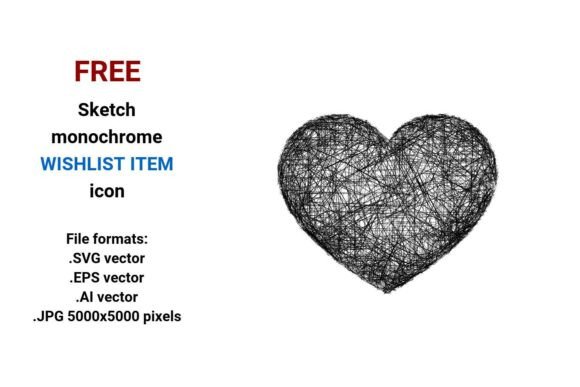
Designing intuitive, emotionally resonant digital interfaces demands assets that balance visual clarity with expressive authenticity. Among the most universally understood interface symbols is the wishlist item — a visual shorthand for desire, intention, and personal curation. The FREE Sketch Wishlist Item Icon meets this need with remarkable precision: a hand-drawn, black-and-white representation of a heart-marked item, delivered in four production-ready file formats — .SVG, .EPS, .AI, and high-resolution .JPG (5000×5000 pixels). Unlike pixel-based alternatives, this is a true vector image: constructed from mathematical paths rather than fixed pixels, enabling infinite scalability without degradation. Whether rendered at 16px in a mobile navigation bar or blown up to 3 meters wide for an interactive retail kiosk, the icon retains crisp edges, consistent stroke weight, and expressive imperfection — hallmarks of authentic sketch style.
Why Vector Matters — Especially for Wishlist Icons
A wishlist item icon isn’t decorative fluff — it’s functional infrastructure. Users click it to save products, compare options, or plan future purchases. In ecommerce, its placement, responsiveness, and consistency directly impact conversion rates and session duration. Raster icons (like standard PNGs or JPGs) blur or pixelate when resized, forcing designers to maintain multiple asset versions — a maintenance burden that compounds across devices, themes, and platforms. A vector image, by contrast, eliminates that friction. Because it’s defined by coordinates, curves, and anchors, not grids of color, the FREE sketch black and white wishlist item icon scales flawlessly from favicon size to billboard resolution. This isn’t theoretical convenience — it’s operational necessity for teams managing Shopify themes, React-based storefronts, Figma design systems, or Adobe XD prototypes.
Consider a real-world workflow: a frontend developer integrates the .SVG version directly into HTML using inline SVG syntax. With CSS, they adjust stroke width on hover, animate fill transitions, or apply dark-mode filters — all without loading external assets or sacrificing performance. Meanwhile, a print designer pulls the .EPS or .AI file into Illustrator to layer it onto packaging mockups or loyalty program brochures, confident that output will match screen previews down to the 0.01mm line. That cross-medium reliability stems from vector fidelity — and the FREE Sketch Wishlist Item Icon delivers it with purpose-built simplicity.
The Power of Sketch Style in Digital Interfaces
Sketch-style icons — characterized by visible pencil strokes, slight line variation, subtle roughness, and intentional asymmetry — do more than look “handmade.” They signal approachability, human intention, and emotional resonance. In a landscape saturated with sterile, over-optimized flat icons, a pen drawn icon like this one introduces warmth without sacrificing clarity. It subtly reinforces the idea that wishlisting is personal, subjective, and human-centered — not just another transactional step.
This aesthetic aligns powerfully with modern UX principles. Research in behavioral design shows that interfaces incorporating organic, low-fidelity elements can reduce perceived cognitive load and increase user trust. A rough, hand drawn sketch icon doesn’t imply amateurism; instead, it suggests transparency and intentionality — as if the design team chose authenticity over automation. For brands building community-driven marketplaces, subscription services, or educational platforms, that nuance matters. A sketch wishlist item icon becomes part of a broader visual language that says: “We’re here with you — not just selling to you.”
Four Formats, Four Distinct Production Roles
The inclusion of four file types isn’t redundancy — it’s role-specific utility:
- .SVG: The web-native format. Embeddable in HTML, manipulable via CSS/JavaScript, accessible via ARIA labels, and SEO-friendly (search engines index SVG content). Ideal for responsive buttons, animated wishlist toggles, and progressive web apps.
- .EPS: Industry-standard for print and legacy vector workflows. Fully compatible with older versions of Adobe Creative Suite and widely accepted by commercial printers. Essential when preparing merch, signage, or physical catalogs featuring the same wishlist motif.
- .AI: Native Adobe Illustrator format. Preserves layers, editable text, and appearance attributes. Enables designers to modify anchor points, adjust stroke profiles, recolor non-destructively, or integrate the icon into larger logo systems or brand guidelines.
- .JPG (5000×5000 px): High-fidelity raster fallback. Used where vector support is limited — certain email clients, legacy CMS editors, or social media ads requiring precise pixel control. Its massive resolution ensures sharpness even when cropped, overlaid with text, or compressed for fast loading.
Together, these formats cover the full spectrum of digital and physical implementation — from live e-commerce interfaces to investor pitch decks, from classroom infographics to mobile app store screenshots. That breadth makes the FREE Sketch Wishlist Item Icon unusually adaptable across disciplines.
Real-World Applications Beyond “Add to Wishlist”
While its primary association is with ecommerce “favorites item” functionality, this icon’s semantic flexibility supports broader use cases:
- Educational Platforms: Marking saved lessons, bookmarked research papers, or curated learning paths. Here, the heart symbolizes intellectual interest — not purchase intent.
- Health & Wellness Apps: Tracking preferred workouts, meal plans, or symptom journals. The wishlist item button becomes a gentle cue for self-care prioritization.
- Research Dashboards: Allowing academics to flag datasets, citations, or visualization templates for later analysis — turning passive browsing into active curation.
- Internal Tools: Product managers using it to tag roadmap items as “customer-requested” or “high-priority”; HR teams marking development goals as “aspirational.”
- Infographic Design: As a sketch style icon within data stories — illustrating user behavior flows, preference mapping, or journey stages where emotional resonance matters more than literal interpretation.
In each case, the icon functions as a symbol, not just a button. Its black-and-white neutrality ensures compatibility with any color system, while its sketch outline avoids competing with surrounding content. It doesn’t shout — it invites.
Accessibility, Performance, and Ethical Implementation
Using a FREE Sketch Wishlist Item Icon responsibly means going beyond aesthetics. Accessibility requires thoughtful integration: always pairing the icon with visible text (“Save for later”) or ARIA labels (aria-label="Add to wishlist") for screen readers. Never rely solely on color or shape to convey meaning — especially critical for users with color vision deficiencies. The black-and-white nature helps, but semantics must be coded, not assumed.
Performance is equally vital. While SVGs are lightweight, embedding large inline SVGs unnecessarily bloats HTML. Best practice? Use external .SVG files with
Finally, consider context. A wishlist icon loses meaning if users don’t understand what happens after clicking it. Pair the sketch wishlist item icon with clear microcopy, persistent visual feedback (e.g., fill animation + toast notification), and transparent backend logic (e.g., syncing across devices, respecting privacy settings). The icon is the doorway — the experience behind it defines trust.
Who Benefits Most — And Why
This resource serves diverse roles with distinct needs:
- Freelance Designers gain a production-ready, licensable asset that saves hours of custom illustration — especially valuable when iterating rapidly for client presentations or pitch decks.
- Ecommerce Developers eliminate dependency on external icon libraries or inconsistent third-party assets — reducing bundle size and improving Lighthouse scores.
- Educators & Researchers use the infographic sketch icon to visualize abstract concepts like preference, selection bias, or user intent in publications and lectures.
- Startup Founders leverage it to prototype MVP interfaces quickly — conveying emotional value without hiring illustrators upfront.
- Nonprofit Communicators adapt it for campaign materials, representing supporter “favorites” — causes, volunteer roles, or donation priorities — with visual empathy.
No single audience “owns” the FREE sketch black and white wishlist item icon. Its strength lies in semantic universality — rooted in the shared human act of choosing, caring, and returning.
Looking Ahead: Simplicity as Strategic Advantage
In an era of increasingly complex design systems, AI-generated assets, and multi-layered interactions, there’s growing strategic value in deliberate minimalism. The FREE Sketch Wishlist Item Icon embodies that principle: one shape, one meaning, zero ambiguity. It doesn’t try to be everything — it does one thing exceptionally well. As interfaces evolve toward voice, gesture, and ambient computing, foundational symbols like this remain anchors. They translate across modalities, cultures, and technologies precisely because they avoid trend-driven ornamentation.
That’s why professionals return to hand-drawn, outline-based icons — not as nostalgia, but as resilience. When your next project calls for a wishlist item icon, a favorites item marker, or simply a quiet visual nod to human preference, this asset offers more than convenience. It offers continuity, clarity, and quiet confidence — drawn once, scaled infinitely, understood instantly.