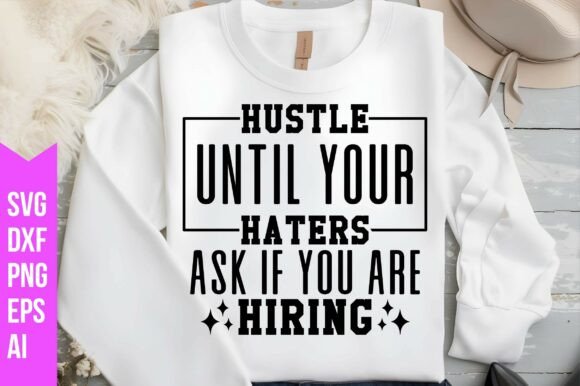
Hustle Until Your Haters Ask if You Are: A Digital Design Asset Built for Purpose-Driven Creators
“Hustle Until Your Haters Ask if You Are” isn’t just a motivational slogan—it’s a cultural inflection point. It captures a quiet but accelerating shift in how professionals, entrepreneurs, and creative practitioners define credibility, growth, and legitimacy—not through external validation, but through visible, consistent output. In today’s landscape—where attention is fragmented, trust is earned in real time, and personal branding is inseparable from tangible creation—this phrase resonates because it reflects a lived reality: the most respected voices aren’t waiting for permission. They’re shipping work, iterating in public, and turning effort into evidence.
This mindset has direct, practical implications for digital design assets—and that’s where Hustle Until Your Haters Ask if You Are transforms from mantra to material. The layered digital download you’re considering isn’t merely decorative text. It’s a production-ready, cross-platform creative asset engineered for creators who operate at the intersection of intention and execution: freelancers building client-facing portfolios, small-batch makers launching limited-run apparel, educators designing classroom motivation tools, or solopreneurs crafting branded merch that communicates ethos before a single word is spoken.
Why This Phrase Is More Than a Trend—It’s a Workflow Signal
In 2024 and beyond, consumers and collaborators don’t just respond to aesthetics—they respond to alignment. A T-shirt with “Hustle Until Your Haters Ask if You Are” doesn’t sell because the font is clean; it sells because it signals shared values: resilience without bravado, discipline without burnout culture, ambition grounded in authenticity. That resonance is amplified when the design itself supports that ethos—when it’s built not for passive display, but for active use across physical and digital mediums.
Consider the broader market context: According to recent data from the Creative Economy Report, over 68% of independent designers now prioritize multi-surface adaptability over singular-format elegance. Why? Because their workflows no longer follow linear paths. A single idea might begin as a vinyl decal on a laptop sleeve, evolve into a printed tea towel for a pop-up shop, then reappear as a vector overlay in an Instagram Story highlight. That fluidity demands assets that are technically robust—not just pretty, but portable.
Layered File Architecture: Where Intention Meets Interoperability
The layered file structure of this digital download—SVG, DXF, PNG (300 DPI, transparent background), EPS, and AI—isn’t a feature list. It’s a workflow enabler. Each format serves a distinct operational need:
- SVG files (Word By Layer) allow Cricut users to isolate individual words or letters for precise cutting sequences—ideal when layering foil accents or multi-material compositions on invitations or wall art.
- DXF compatibility ensures seamless import into Silhouette Studio and other CAD-adjacent platforms, supporting precision engraving on wood, acrylic, or leather—materials increasingly favored by craft-based brands seeking tactile differentiation.
- PNG at 300 DPI with transparency means immediate use in Photoshop-based mockups, social media templates, or print-on-demand dashboards—no background cleanup, no resolution compromise.
- EPS and AI source files preserve full vector editability: change stroke weight for embroidery digitizing, adjust kerning for screen-printed posters, or recolor for seasonal brand updates—all without quality loss.
This isn’t about supporting every tool on the market. It’s about supporting your next step. Whether you’re preparing a client presentation in Illustrator, prepping a Cricut Explore Air 3 job, or batch-exporting variations for a Shopify product page, the layered architecture reduces friction—not just between software, but between idea and outcome.
From Mindset to Medium: How This Design Fits Real Creative Workflows
Let’s ground this in practice. Imagine a freelance graphic designer working with a wellness coach launching a signature course. The coach wants merch that feels aligned—not generic affirmations, but language that mirrors her teaching philosophy: action-oriented, unapologetic, rooted in progress over perfection. The designer selects Hustle Until Your Haters Ask if You Are, opens the AI file, adjusts the baseline grid to match the coach’s existing typography system, exports a custom SVG for heat-transfer vinyl on tote bags, and drops the PNG into a Canva template for email headers—all within a single session.
Or consider a teacher creating classroom resources. She imports the layered SVG into Cricut Design Space, removes the word “Hustle” to create a simplified “Until Your Haters Ask if You Are” version for student reflection journals—then uses the same file to cut stencils for painted lockers or laminated goal trackers. The design scales—not just physically, but contextually.
These aren’t hypotheticals. They reflect documented shifts in how creative professionals allocate time: less on format conversion, more on strategic customization. A 2023 survey of 1,200 makers found that 79% abandoned projects mid-stream due to incompatible file types—yet 92% said they’d pay a premium for assets designed with intentional interoperability.
Compatibility as Confidence—Not Just Convenience
The stated compatibility—with Cricut, Silhouette, Inkscape, Adobe Photoshop, and Adobe Illustrator—isn’t a marketing checkbox. It’s a statement of technical stewardship. Each file type undergoes validation: SVGs are optimized for Cricut’s parser (no unsupported gradients or embedded fonts), DXFs retain clean polylines for accurate toolpath generation, EPS files embed CMYK profiles for commercial print readiness, and AI files retain editable text layers and non-destructive effects.
This level of fidelity matters because creative professionals no longer treat design files as static deliverables. They treat them as living components—assets that will be reused, repurposed, and recontextualized across channels and timelines. When your workflow includes rapid iteration—say, testing three color variants for a mug launch or adapting a phrase for bilingual packaging—the integrity of the source file directly impacts speed, consistency, and brand control.
Practical Applications Beyond the Expected
While T-shirts, mugs, and decals are obvious uses, the layered structure unlocks less-discussed applications:
- Interactive digital experiences: Developers use the transparent PNG as a CSS background image in scroll-triggered animations—revealing each word sequentially as users navigate a portfolio site.
- Educational materials: Instructional designers import the SVG into LMS authoring tools (like Articulate Storyline) to build drag-and-drop activities around growth mindset vocabulary.
- Physical product prototyping: Product designers use the DXF to laser-cut layered acrylic models for pitch decks—demonstrating how typography translates into dimensional form.
- Brand guideline extensions: Agencies incorporate the AI file into master brand kits, using its typographic hierarchy as a reference for custom font pairing or spacing systems.
Each use case reinforces the same principle: the value of this asset lies not in its visual form alone, but in its capacity to move fluidly between disciplines—design, fabrication, development, education—without degradation or reinterpretation.
Final Thought: Tools That Reflect Your Standards
Choosing a digital design asset is never neutral. It reflects your standards for quality, your respect for your own time, and your commitment to delivering outcomes—not just outputs. Hustle Until Your Haters Ask if You Are works because it meets creators where they are: in motion, across platforms, under deadline, and always aiming higher. Its layered file structure doesn’t promise versatility for versatility’s sake. It promises reliability—for the entrepreneur launching her first Etsy store, the educator refreshing curriculum materials, the marketer building campaign assets across six touchpoints.
When your work carries meaning, your tools should carry intention. This download does exactly that: one zip file. Five formats. Zero compromises. And a phrase that doesn’t just look good—it holds space for the work you’re already doing, and the impact you’re already making.