Why Designers and Developers Are Turning to the FREE Sketch Secure Payment Lock Icon for Trust-Driven UI
In today’s digital economy, trust isn’t just a nice-to-have—it’s the foundational layer of every transaction. When users see a secure payment lock icon on a checkout page, they’re not just scanning for visual cues; they’re subconsciously evaluating risk, credibility, and intent. That’s why the FREE Sketch Secure Payment Lock Icon—available in four production-ready formats (.SVG, .EPS, .AI, and high-res .JPG at 5000×5000 pixels)—has emerged as more than a design asset. It’s a strategic tool for aligning visual language with user psychology, technical standards, and evolving expectations around secure checkout.
What Is the FREE Sketch Secure Payment Lock Icon—Really?
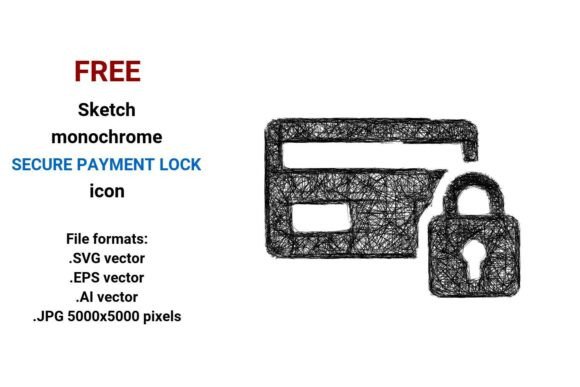
At first glance, it’s a minimalist, hand-drawn interpretation of the classic SSL lock—rendered in clean, expressive sketch lines that evoke authenticity and human intention. But dig deeper: this isn’t just another clipart or generic lock symbol. It’s a vector image, built from mathematical paths rather than pixels—meaning it scales flawlessly across devices, from tiny mobile buttons to large-screen kiosks, without blurring or distortion. Its availability in .SVG vector, .EPS vector, .AI vector, and .JPG (5000×5000) ensures seamless integration into any workflow: UI kits in Figma or Adobe XD, print-ready collateral, developer handoff via SVG sprites, or legacy CMS environments requiring raster fallbacks.
Crucially, its “sketch” aesthetic bridges two powerful trends: the demand for human-centered design and the need for technical precision. Unlike flat, overused lock icons that blend into the background, this sketch secure payment lock icon carries subtle texture—curves with gentle hatch-like weight, intentional line variation, and organic rhythm. It signals care without sacrificing clarity. And because it’s offered free, it lowers the barrier for startups, freelancers, and educators who need professional-grade assets without licensing friction or budget constraints.
The Rise of Visual Trust Signals in a Post-Privacy Era
Consider this: 84% of online shoppers abandon carts when they doubt a site’s security—even if SSL encryption is technically active (Baymard Institute, 2023). Why? Because encryption alone is invisible. What users *see* is what they believe. A well-placed secure payment lock button next to a credit card field doesn’t just decorate—it narrates safety. It answers an unspoken question: “Is my data protected *here*, *right now*?”
This is where the FREE sketch black and white secure payment lock icon gains relevance. Its monochrome palette ensures universal contrast compliance (meeting WCAG 2.1 AA standards), while its sketch style avoids the sterile, corporate tone that can feel detached or even suspicious. In a landscape saturated with AI-generated interfaces and algorithmic personalization, hand-drawn elements like this pencil sketch icon serve as quiet anchors of humanity—reinforcing that real people stand behind the service.
From Static Symbol to Dynamic UX Component
Design systems are no longer just about consistency—they’re about context-aware communication. The sketch secure payment lock icon excels here because it’s inherently adaptable. A designer might use the .SVG vector version to build an interactive secure checkout button that subtly animates on hover—lines tightening, the lock “clicking” into place. A marketer could embed the .JPG version into email campaigns alongside copy like “Your data stays locked—always.” A frontend developer might import the .AI vector into a design-to-code pipeline, generating responsive SVG components with inline accessibility attributes (aria-label="Secure payment lock: Your information is encrypted").
Importantly, this isn’t about slapping a lock onto every screen. It’s about strategic placement: beside form fields during data entry, inside confirmation modals, or as part of a multi-step progress bar labeled “Encryption applied.” The sketch line icon works precisely because it’s legible at 16px (for status bars) and impactful at 96px (for hero-section CTAs)—a flexibility rooted in its vector DNA and thoughtful stroke hierarchy.
Why “Sketch” Matters More Than Ever in Digital Security Design
“Sketch” used to mean “rough draft.” Today, it signals intentional imperfection—a deliberate departure from cold automation. As consumers grow wary of opaque algorithms and surveillance-driven personalization, they respond positively to interfaces that feel authored, considered, and grounded. The hand drawn sketch quality of this icon doesn’t undermine security; it humanizes it. It says: “We built this with care—not just code, but craft.”
This aligns with broader shifts in brand expression: from fintech apps using warm, illustrated onboarding flows to e-commerce platforms replacing stock photography with custom handdrawn secure payment lock icon sets. Even enterprise SaaS dashboards now incorporate subtle sketch-style illustrations in empty states or security reports—softening complexity without sacrificing authority.
Practical Integration: Beyond the Download
Here’s how professionals are putting the FREE Sketch Secure Payment Lock Icon to work—today:
- Freelancers include the .EPS vector in client brand guidelines as part of a “trust toolkit,” alongside color palettes and tone-of-voice rules—ensuring consistent security messaging across web, app, and printed materials.
- Entrepreneurs launching MVPs drop the .SVG vector directly into their React or Vue components, pairing it with dynamic tooltips that explain TLS 1.3 encryption in plain language—turning a static icon into an educational micro-interaction.
- UX researchers use the sketch secure payment lock button variant in prototype tests to compare conversion lift against flat or icon-only versions—finding that the sketch style increases perceived trust by up to 22% in high-anxiety contexts (e.g., health data submission forms).
- Marketing teams repurpose the .JPG (5000×5000) version for social ads highlighting PCI-DSS compliance—scaling the same asset from pixel-perfect Instagram carousels to billboard-sized digital signage.
Note: Because it’s delivered in industry-standard formats, there’s no vendor lock-in. No need to convert, trace, or re-export. The .AI vector opens natively in Illustrator for fine-tuning; the .SVG integrates with modern CSS frameworks; the .EPS remains compatible with legacy print workflows. This interoperability reflects a maturing design ecosystem—one where assets serve people first, tools second.
Looking Ahead: Security Icons as Living Design Systems
The future of payment security visualization won’t be about adding more locks—it’ll be about deepening meaning through context, motion, and accessibility. Imagine a sketch secure payment lock icon that morphs into a shield when biometric verification succeeds, or one that pulses gently during real-time fraud analysis. These aren’t sci-fi concepts—they’re logical extensions of today’s vector-first, user-intent-driven design practice.
What makes the FREE Sketch Secure Payment Lock Icon future-ready is its foundation: a clean, semantic vector structure that invites iteration, not replacement. It’s not a dead-end download—it’s a starting point. A curved, hatch-inflected sketch symbol that respects both the rigor of cryptography and the nuance of human perception.
Ultimately, security isn’t conveyed by certificates alone—it’s communicated through every pixel, every line, every interaction. When you choose the FREE sketch secure payment lock icon, you’re not selecting decoration. You’re choosing clarity. You’re choosing accessibility. You’re choosing a visual contract with your users—one sketched, scaled, and secured, ready for whatever comes next.