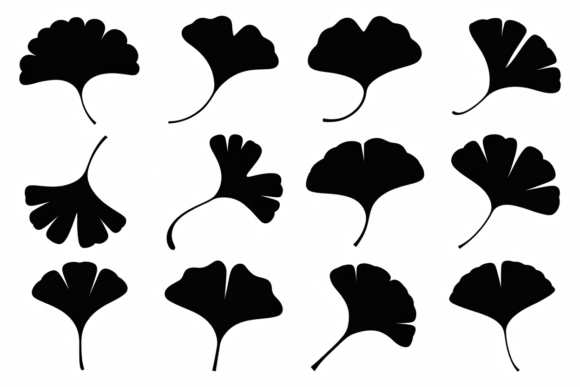
Ginkgo Leaf Silhouettes Vector Pack
The ginkgo biloba tree—ancient, resilient, and instantly recognizable—has long symbolized longevity, hope, and quiet strength. Its distinctive fan-shaped leaf, with delicate bifurcated veins and clean contours, translates beautifully into minimalist design. That’s why the Ginkgo Leaf Silhouettes Vector Pack isn’t just another clipart collection: it’s a thoughtfully engineered toolkit for creators who value both aesthetic integrity and technical flexibility.
Why Precision Matters in Today’s Creative Workflows
Modern makers no longer settle for pixelated PNGs or low-res JPEGs that blur at scale. Whether you’re cutting vinyl on a Cricut Maker, layering elements in Adobe Illustrator for a boutique apparel line, or prepping files for a local print shop, vector-based assets are non-negotiable. The Ginkgo Leaf Silhouettes Vector Pack delivers exactly that—crisp, mathematically defined outlines built from Bézier curves, not raster approximations. Each silhouette is hand-optimized: anchor points are minimized without sacrificing shape fidelity, paths are closed and clean, and fills and strokes are set to default “no fill, 1pt stroke” for maximum adaptability.
This level of precision reflects a broader shift in how creative professionals approach digital assets. Designers, small-business owners, and educators increasingly treat vector files as modular building blocks—not static images. A single ginkgo silhouette can become a monogram on a ceramic mug, a repeating pattern on a tote bag lining, or a layered stencil for botanical-themed wall art. Because it’s scalable without loss, it performs equally well at 0.5 inches (for jewelry engraving) or 48 inches (for a gallery wall installation).
Fitting Into Real-World Creative Practices
Consider the typical day of a freelance surface pattern designer: they might start by sketching motifs in Procreate, then refine one into a vector using Illustrator—only to realize they need a consistent botanical motif library for client presentations. Or imagine a teacher preparing a nature unit for middle school students: they want printable stencils for leaf rubbings, cut-out templates for science journals, and editable SVGs for a classroom vinyl cutter project. In both cases, the Ginkgo Leaf Silhouettes Vector Pack reduces friction. It eliminates the need to trace, redraw, or source inconsistent free assets—and avoids licensing pitfalls common with generic stock sites.
Similarly, small-batch apparel brands often rely on direct-to-garment (DTG) printing or heat-transfer vinyl (HTV). These methods demand clean, simplified shapes with minimal internal detail—exactly what silhouettes provide. Ginkgo leaves offer subtle sophistication without visual clutter, appealing to customers seeking understated elegance over loud graphics. That quiet confidence aligns with current consumer preferences: research from trend analysts at WGSN and Pantone shows sustained growth in “quiet luxury” aesthetics across fashion, home goods, and lifestyle branding—where meaning, materiality, and restraint matter more than saturation or complexity.
Format Flexibility Meets Platform Reality
The inclusion of both SVG and EPS files isn’t just a checkbox—it addresses real-world software constraints and user roles. SVG is the standard for craft-cutting machines like Cricut Explore Air 2, Cricut Maker, and Silhouette Cameo 4. Its XML structure allows precise path control, making it ideal for intricate cuts or multi-layered projects (e.g., layering a gold foil ginkgo over matte black vinyl). Users of Silhouette Studio Designer Edition benefit especially: the SVG imports natively, preserving grouping and layer hierarchy so adjustments stay intuitive.
EPS, meanwhile, remains essential for professional graphic designers working in Adobe Illustrator, CorelDRAW, or Affinity Designer. Unlike SVG, EPS supports legacy color models (like spot colors for screen printing), advanced clipping masks, and embedded fonts—critical when integrating the ginkgo motif into larger brand systems or packaging mockups. Because EPS is resolution-independent and editable at the path level, a marketing director can easily recolor the leaf to match a seasonal campaign palette or adjust stroke weight for legibility on outdoor signage.
Practical Applications Beyond the Obvious
While the pack highlights common uses—apparel, drinkware, decals, fabric projects, wall art, and scrapbooking—the real value emerges in less-discussed applications:
- Educational tools: Biology teachers use the silhouettes to label plant anatomy diagrams; Montessori educators print them on textured paper for tactile sorting activities.
- Accessibility adaptations: Clean silhouettes translate well to tactile graphics for visually impaired learners when embossed or cut with raised-line settings.
- Brand identity scaffolding: A wellness studio might use the ginkgo as a subtle watermark across digital newsletters, then scale it up for reception area wall decals—maintaining visual continuity across touchpoints.
- Sustainable product labeling: Eco-conscious brands apply the motif to compostable packaging as a natural, non-corporate symbol of renewal—avoiding clichéd green icons or overused leaf tropes.
These aren’t hypotheticals. A Portland-based herbal apothecary recently used this exact vector pack to unify their product line: ginkgo silhouettes appear laser-etched on reusable glass jars, embroidered on organic cotton drawstring bags, and printed on seed paper tags that customers can plant. Consistency came not from repetition alone, but from having one source file adapted intelligently across materials and scales.
What Has Changed—and Why Now?
Fifteen years ago, botanical vectors were often bundled with watermarks, limited licenses, or inconsistent styles. Today’s users expect ethical sourcing, transparent usage rights, and interoperability across tools. They also expect speed—without compromising quality. The rise of AI-assisted design tools has heightened awareness of vector hygiene: poorly constructed paths cause errors in auto-trace features or fail during automated batch processing. This pack was built with those realities in mind—tested across multiple platforms, validated for nesting efficiency in cutting software, and stripped of unnecessary metadata that slows import times.
Additionally, interest in ginkgo specifically has grown alongside broader cultural attention to longevity science, neuroprotection research, and urban greening initiatives. Cities like Seoul and Toronto have planted thousands of ginkgo trees for their pollution resistance and disease resilience—a quiet echo of the values the leaf represents. Using its silhouette becomes more than decorative; it’s a subtle nod to endurance, adaptation, and mindful growth.
A Resource That Grows With You
You don’t need to be a full-time designer to benefit from the Ginkgo Leaf Silhouettes Vector Pack. Hobbyists learning Silhouette Studio can start with a single leaf, resize it for a tumbler wrap, and experiment with mirror cuts for symmetrical window decals. A blogger documenting a garden renovation might use the EPS version to overlay labeled ginkgo diagrams onto drone photos in Illustrator. A startup founder launching a mindfulness app could incorporate the silhouette into UI icons, ensuring visual harmony between digital and physical brand assets.
What makes this pack sustainable—not just ecologically, but practically—is its neutrality. It doesn’t impose a style (vintage, grunge, neon, hyperrealistic). Instead, it offers clarity: one strong, timeless shape, ready to absorb your voice, your process, your purpose. In an era where creative fatigue is real and attention spans are fragmented, returning to foundational, well-made elements isn’t nostalgic—it’s strategic.
When your next project calls for something grounded yet graceful, simple yet meaningful, consider how a single ginkgo leaf—rendered with care, delivered in usable formats, and designed for real workflows—can do more than decorate. It can anchor.