FREE Sketch Organ Icon: Hand-Drawn & Scalable
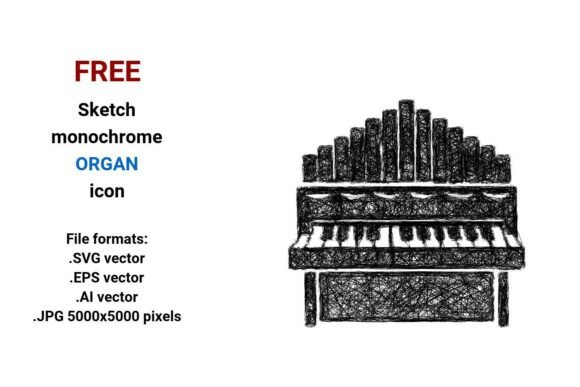
Need an expressive, versatile organ icon that feels human-made—not robotic or over-polished? The FREE Sketch Organ Icon delivers exactly that: a clean, black-and-white line-art interpretation of a pipe organ, crafted in sketch style and available in four professional formats—.SVG, .EPS, .AI, and high-res .JPG (5000×5000 px). It’s not just another clipart download. It’s a flexible visual tool built for real creative work—whether you’re designing a music education app, branding a choir newsletter, or illustrating a vintage-inspired blog post about keyboard history.
Why This Sketch Organ Icon Stands Out
Unlike generic flat icons or photorealistic organ images, this FREE Sketch Organ Icon balances clarity with character. Its hand-drawn quality—subtle hatch marks, slight line variation, gentle curves—adds warmth without sacrificing legibility. Because it’s a vector image, every detail holds up whether scaled to 24px for a mobile UI button or stretched across a 48" trade show banner. No pixelation. No quality loss. Just consistent, intentional design.
The black-and-white palette makes it highly adaptable: pair it with bold color overlays for digital interfaces, print it on kraft paper for artisanal program covers, or layer it into a textured background for editorial illustrations. And since it’s rooted in the visual language of pen sketch, pencil sketch icon, and line art, it fits naturally alongside other hand-crafted elements—no jarring stylistic mismatch.
Creative Uses Across Real Projects
This isn’t just an “organ icon”—it’s a starting point for thoughtful visual communication. Here’s how different users are putting it to work:
- Music educators use the pipe organ icon as a recurring visual anchor in lesson plans, worksheets, and student-facing slide decks—its sketch style feels approachable, not intimidating.
- Web designers integrate the .SVG vector version directly into navigation bars or as interactive organ button elements, leveraging its crisp edges and minimal file size for fast-loading pages.
- Small business owners (like boutique piano tuners or historic church restoration services) adapt the sketch organ icon into letterheads, social media banners, and email signatures—adding subtle brand personality without heavy custom illustration costs.
- Bloggers and content creators drop the .JPG 5000×5000 version into feature images for posts on Baroque music, organ building, or keyboard instrument evolution—ensuring sharp detail even on retina displays.
- UI/UX teams build consistent icon systems by pairing this flat sketch icon with complementary hand-drawn assets (e.g., a sketch keyboard icon or music icon), maintaining cohesion across dashboards or learning platforms.
How to Adapt It Thoughtfully
One size doesn’t fit all—and that’s why having four formats matters. Use .AI or .EPS if you need full editability in Adobe Illustrator: adjust stroke weight, recolor individual pipes, or isolate sections for animation. Choose .SVG for web embedding—add CSS hover effects, animate pipe highlights, or embed inline for accessibility. Rely on the .JPG only when you need maximum compatibility (e.g., PowerPoint presentations, printed brochures, or CMS platforms that don’t support vectors).
Keep adaptations audience-friendly: avoid over-stylizing the sketch if your users value clarity (e.g., older learners or accessibility-first designs). If using it as a button, ensure contrast meets WCAG 2.1 standards—test against both light and dark backgrounds. For branding, consider pairing the icon with a simple, readable typeface and no more than two accent colors to preserve its rough, creative sketch concept integrity.
Going Beyond the Obvious: Unexpected Applications
This FREE Sketch Organ Icon works well outside traditional music contexts. A local history museum used it in an exhibit timeline about 19th-century civic architecture—labeling buildings that housed pipe organs as cultural landmarks. A typography student layered it into a poster exploring the relationship between musical notation and letterform rhythm. An indie game developer repurposed the pipe shapes as stylized terrain elements in a puzzle game about acoustics.
These aren’t gimmicks—they’re examples of treating the icon as a visual motif, not just a label. Its isolated, curves-forward composition invites reinterpretation: rotate pipes to suggest movement, mirror sections for symmetry studies, or trace outlines to generate custom patterns. Because it’s hand drawn sketch—not AI-generated—it carries subtle imperfections that spark human connection and creative curiosity.
Maintaining Quality and Consistency
When incorporating the FREE Sketch Organ Icon into larger projects, consistency starts with intention. Decide early: is this icon a functional element (organ button, navigation cue) or a decorative one (background texture, watermark)? That choice guides scale, placement, and treatment. For UI work, stick to one size range (e.g., 24–48px) and maintain uniform stroke weight across all icons in your set. For print, confirm your printer supports vector files—or convert to high-DPI raster only when necessary.
Also consider context. An artistic, sketchy icon may feel out of place in a sleek fintech dashboard—but perfect for a community music nonprofit’s annual report. Match tone to purpose. If your audience values craftsmanship, lean into the pen drawn icon qualities—highlight the linework, reference the process in captions, or even share a behind-the-scenes note about why sketch style was chosen.
Ready to Use—No Strings Attached
This FREE Sketch Organ Icon is truly free: no attribution required, no watermarks, no paywalls. It’s designed to remove friction—not add it. Whether you’re prototyping a new music app, refreshing course materials, or building a personal portfolio site, it’s ready to serve your goals without compromise. And because it’s built as a vector organ button, sketch clipart, and icon vector all at once, you’re not choosing between flexibility and fidelity—you get both.
Start simple. Drop the .SVG into a Figma file. Test the .JPG in a Canva template. Open the .AI file and experiment with re-coloring one pipe section. See how it behaves. Then build from there—confidently, clearly, and creatively.