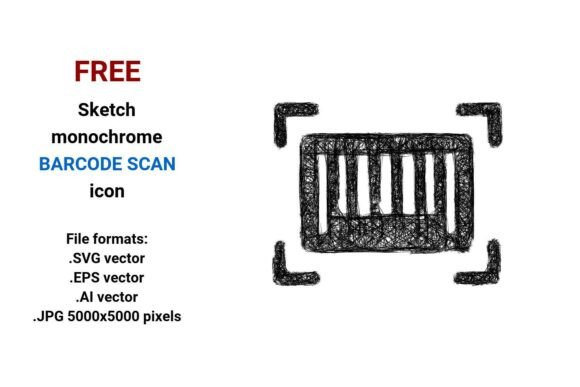
FREE Sketch Barcode Scan Icon: A Scalable, Hand-Drawn Asset for Medicine Scan and Pharmacy Interfaces
When designing digital tools for healthcare environments—especially pharmacy management systems, prescription tracking apps, or clinical inventory dashboards—the visual language must balance clarity, trust, and human-centered warmth. The FREE Sketch Barcode Scan Icon meets this need precisely: it’s not a sterile, machine-perfect symbol, but a deliberately hand-drawn, monochrome sketch style representation of a barcode scan action—designed to feel approachable without sacrificing functionality.
Why Sketch Style Matters in Medical and Pharmacy Contexts
In high-stakes settings like hospitals, community pharmacies, or telehealth platforms, interface elements carry subtle psychological weight. A rigid, ultra-polished icon may signal precision—but also coldness or distance. In contrast, a sketchy, outline sketch icon conveys intentionality, accessibility, and human oversight—qualities that resonate with patients verifying prescriptions, pharmacists scanning vials, or technicians auditing stock. This isn’t about aesthetic preference alone; it’s about UX alignment. Studies in health IT usability show that interfaces incorporating handdrawn vector icon elements reduce perceived cognitive load during rapid data entry—particularly when users are multitasking under time pressure.
The FREE sketch black and white barcode scan icon leans into this principle. Its pen- and freehand-inspired linework avoids optical illusions or unintended visual noise—critical when icons appear on small mobile screens or printed labels. Unlike photorealistic or gradient-heavy alternatives, its monochrome sketch icon nature ensures legibility across diverse display technologies, including low-resolution kiosks or older tablet models still in use across rural clinics and long-term care facilities.
Four File Formats, One Consistent Vector Foundation
This asset is delivered in four complementary formats—.SVG vector, .EPS vector, .AI vector, and .JPG (5000×5000 pixels)—each serving distinct production needs while preserving the same core design integrity.
- .SVG vector: Ideal for web-based pharmacy portals, EHR integrations, and responsive patient-facing applications. SVGs scale infinitely without pixelation and support CSS animation—enabling subtle hover states (e.g., a gentle pulse on the scanner beam) to guide user attention during medicine scan workflows.
- .EPS vector: Used primarily in print-ready materials—such as laminated workflow posters in dispensary stations, training handouts for pharmacy technicians, or compliance documentation. EPS maintains crisp edges at any physical size, from business-card–sized quick-reference guides to wall-mounted safety protocols.
- .AI vector: Enables direct editing within Adobe Illustrator for designers customizing color schemes (e.g., applying brand-aligned accent hues to the scanner outline), adjusting stroke weights for accessibility, or combining the icon with custom typography for internal toolkits.
- .JPG (5000×5000 pixels): Serves as a high-resolution fallback for legacy CMS platforms, email templates, or presentations where vector support is limited. Though raster-based, its extreme resolution allows safe downscaling to thumbnails, banners, or slide decks without visible degradation—making it practical for cross-departmental communications between pharmacy leadership, IT teams, and regulatory staff.
Crucially, all four files originate from the same vector image source. As a vector image, it’s built from mathematical paths—not pixels—meaning every curve, angle, and endpoint remains mathematically exact regardless of scale. That’s why a single sketched barcode scan button can render flawlessly on a 4K diagnostic monitor and simultaneously function as a touch target on a 3.5-inch pharmacy tablet—without requiring multiple asset versions or manual rework.
Real-World Applications Across Healthcare Workflows
The FREE Sketch Barcode Scan Icon integrates seamlessly into varied scenarios where medicine scan actions drive accuracy and accountability:
- Pharmacy Dispensing Stations: Embedded in touchscreen interfaces, the icon acts as a primary barcode scan button for verifying NDC codes on medication bottles before dispensing. Its isolated, graphic composition prevents visual competition with dense alphanumeric fields or warning banners.
- Mobile Medication Adherence Apps: Used as an app sketch icon for the “Scan Prescription” feature, its mobile sketch icon proportions and clear negative space ensure thumb-friendly tappability—even with gloves or reduced dexterity.
- Clinical Trial Inventory Logs: Applied in Excel-based or Airtable-managed trackers, the clipart-ready .SVG or .JPG version helps researchers quickly distinguish scan-initiated entries from manual inputs—a subtle but critical audit trail enhancement.
- Educational Simulations: Nursing and pharmacy students interact with virtual dispensing labs where the sketch barcode scan icon reinforces procedural fidelity. Its line art simplicity avoids distraction while supporting multimodal learning—students narrate steps aloud while clicking the icon, reinforcing muscle memory and terminology.
Design Integrity Meets Technical Practicality
Unlike generic clipart or overused stock icons, this sketch barcode scan button was developed with deliberate constraints: no fill colors, no gradients, no drop shadows. Why? Because in pharmacy UIs, consistency trumps novelty. A scalable, outline form ensures harmonious pairing with system fonts (like Roboto or Inter), status indicators (checkmarks, warnings), and other design elements in a cohesive component library.
Its scribble-adjacent texture is intentional—not messy, but expressive. Each line variation reflects how a human might draw a scanner: slightly tapered strokes for the beam, confident arcs for the housing, and a subtle asymmetry in the barcode lines that echoes real-world label imperfections. This authenticity supports user recognition faster than abstract geometric interpretations. When a pharmacist glances at a screen mid-task, they don’t decode shapes—they match visual patterns to mental models. The sketch style here mirrors that lived experience.
Moreover, its black and white foundation makes it WCAG-compliant out of the box. When paired with sufficient contrast backgrounds (e.g., light gray or soft blue), it meets AA standards for non-text contrast—essential for aging professionals or those with mild visual impairments common in healthcare workforces.
Strategic Considerations for Implementation
Adopting the FREE Sketch Barcode Scan Icon goes beyond drag-and-drop replacement. Consider these practical factors:
- Contextual Pairing: Never isolate the icon without supporting text in production interfaces. Even with intuitive design, always pair it with a label like “Scan Medicine Label” or “Verify Prescription” — especially in multilingual environments where visual-only cues risk ambiguity.
- Animation Restraint: While SVG enables motion, avoid animated scanner beams in clinical settings. Subtle transitions (e.g., stroke opacity shift on hover) aid discoverability; looping animations can distract during urgent tasks or trigger sensory sensitivities.
- Localization Readiness: The icon itself requires no translation—but ensure accompanying copy accounts for regional terminology. “Barcode scan” may be preferred in U.S. pharmacy software, while “product code scan” appears more frequently in EU-facing tools. The vector barcode scan button stays constant; only textual context adapts.
- Version Control: Store the .AI and .EPS files as master sources. Treat the .SVG as the production web asset and the .JPG as the archival raster backup. This prevents accidental edits to derivative files and maintains traceability during audits.
Broader Implications for Health Tech Design
The rise of sketched, handdrawn vector icon assets like this one signals a maturing discipline in health IT design—one that values empathy alongside engineering rigor. It reflects an understanding that medicine scan isn’t just about reading a pattern; it’s about affirming safety, enabling verification, and honoring the human labor behind every dispensed dose. Tools built with such intentionality foster trust—not just in software, but in the systems supporting patient care.
For educators building simulation curricula, this icon sketch serves as a teaching artifact: a concrete example of how vector mathematics, visual cognition, and domain-specific needs intersect. For researchers studying medication error reduction, it offers a measurable variable—comparing task completion time and error rates between interfaces using this outline sketch icon versus conventional alternatives.
Ultimately, the FREE Sketch Barcode Scan Icon is more than a download—it’s a small but meaningful commitment to designing *with*, not just *for*, the people who keep healthcare running: the pharmacists double-checking doses, the technicians restocking shelves, the students learning under pressure, and the patients placing quiet faith in every scanned label.