Free Sketch Carbon Footprint Icon: A Versatile, Scalable Asset for Sustainability Design
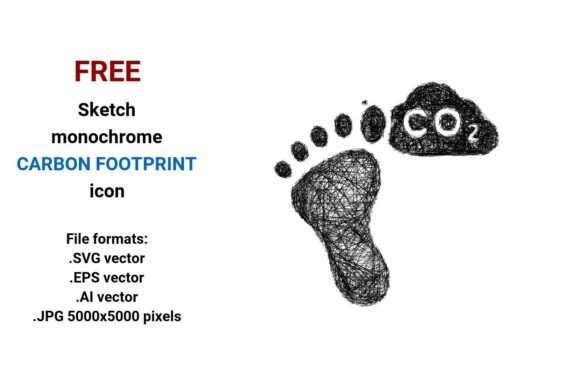
Designers, developers, and sustainability communicators increasingly need visual tools that are both meaningful and technically flexible. The FREE Sketch Carbon Footprint Icon meets that need — not just as a symbol, but as a functional, production-ready design element. With its hand-drawn aesthetic and clean monochrome execution, it bridges authenticity and usability in ways that flat, over-polished icons often can’t.
Why Sketch Style Works for Environmental Messaging
A carbon footprint isn’t an abstract data point — it’s a human-scale concept tied to daily choices: driving, heating homes, powering devices, shipping goods. A sketch-style icon reflects that humanity. Its slight irregularity — the subtle wobble in a line, the gentle curve of a pen stroke — signals intentionality, care, and approachability. Unlike sterile geometric icons, a sketch carbon footprint icon invites engagement rather than passive scanning.
This isn’t about sacrificing professionalism. In fact, modern UX and branding increasingly favor rough, line sketch, and hand drawn icon styles — especially in sustainability, education, and civic tech. Why? Because they subtly signal transparency, humility, and action-oriented thinking. When users see a pen drawn icon next to a “Reduce Your Emissions” button, the message feels grounded — not corporate-speak.
Four Formats, One Seamless Workflow
The FREE Sketch Carbon Footprint Icon comes in four essential formats: .SVG vector, .EPS vector, .AI vector, and .JPG (5000×5000 pixels). That range isn’t just convenient — it’s strategic.
- .SVG vector: The go-to for websites and apps. It loads fast, scales infinitely without blurring, and supports CSS styling (e.g., hover color shifts or animated strokes). Perfect for carbon footprint buttons, dashboard widgets, or interactive infographics.
- .EPS and .AI vector: Industry-standard for print, branding guidelines, and high-res collateral. Need to drop the icon into a brochure about green energy incentives? Or scale it across a 20-foot exhibition banner? These formats preserve every curve and anchor point — no pixelation, no guesswork.
- .JPG (5000×5000): High-resolution raster fallback. Ideal for presentations, social media assets, or platforms that don’t support SVG natively. At this size, it holds crisp detail even when zoomed or cropped tightly.
That multi-format availability means you’re never forced to compromise. No more stretching low-res PNGs or redrawing vectors from scratch. Whether you’re a solo developer building a climate calculator or a marketing team launching a green energy campaign, the files slot right in — no conversion headaches, no licensing friction.
What Makes This a True Vector Image?
A vector image isn’t just “scalable.” It’s built on math — points, paths, Bézier curves — not fixed pixels. That’s why your carbon footprint vector stays razor-sharp whether it’s 16px tall in a mobile nav bar or 3 meters wide on a solar farm visitor center wall.
Unlike raster images (like standard JPGs or PNGs), vectors retain editability. Open the .AI or .EPS file in Illustrator or Affinity Designer, and you can adjust stroke weight, tweak anchor points, recolor individual layers, or isolate the leaf motif from the footprint shape. That flexibility is invaluable for customizing tone — say, softening lines for a youth-focused climate app or tightening curves for a technical emissions dashboard.
Practical Use Cases Across Industries
This icon doesn’t live in isolation. It thrives in context — especially where clarity, speed, and emotional resonance matter.
- Emissions tracking dashboards: Pair the emissions button with real-time CO₂ metrics. Its sketch style visually distinguishes actionable controls from static charts.
- Green energy landing pages: Use it beside headlines like “Switch to Renewable Power” or “Calculate Your Clean Energy Savings.” Its monochrome palette ensures contrast against vibrant gradients or sky-blue backgrounds.
- Educational tools: Teachers use the scribble and rough qualities to spark conversation — “What does your footprint look like?” — making abstract data feel tangible.
- Sustainability reports & PDFs: Embed the .EPS version to guarantee print fidelity, even in dense documents with dozens of icons.
- UI kits & design systems: Drop the .SVG into Figma or Sketch libraries. Its consistent stroke width and balanced negative space make it interoperable with other ux sketch icon sets.
Design Integrity Meets Real-World Constraints
Not all carbon-related icons succeed. Some are too literal (a smokestack), too vague (a generic globe), or too busy (overlapping symbols). This sketch style icon avoids those pitfalls by focusing on three core traits:
- Recognition at small sizes: Even at 24px, the footprint + leaf combo reads instantly — no squinting required.
- Neutral tonality: Black and white means it adapts to any brand palette — whether paired with forest green for an NGO or electric blue for a smart-grid startup.
- Emotional warmth: The slight unevenness of the line work implies human effort — aligning perfectly with themes of responsibility, transition, and collective action.
It also respects accessibility. The strong contrast ratio (black on white or vice versa) meets WCAG 2.1 AA standards for icons used as interactive elements — critical for carbon footprint button labels or form controls.
Choosing the Right Format for Your Project
You don’t always need all four files — but knowing when each shines saves time and preserves quality.
- Building a responsive website? Start with the .SVG. Add fallbacks only if supporting legacy browsers (rare today).
- Creating a logo lockup for a carbon-offset startup? Use the .AI to fine-tune spacing and export precise brand assets.
- Preparing investor pitch decks? The .JPG gives pixel-perfect consistency across PowerPoint, Keynote, and PDF exports.
- Contributing to open-source climate toolkits? Share the .SVG — lightweight, editable, and universally supported.
And remember: because it’s a FREE Sketch Carbon Footprint Icon, there’s zero friction to test-drive it across scenarios. Try it as a favicon, a Slack reaction, a progress indicator in a carbon-reduction challenge — then scale up once you know it fits.
More Than an Icon — A Design Philosophy
In a world saturated with climate visuals — some alarmist, some overly optimistic, many forgettable — this icon stands out by being quietly confident. It doesn’t shout. It doesn’t oversimplify. It doesn’t hide complexity behind slickness. Instead, it offers a curve, a stroke, a footprint — all rendered with the honesty of a pencil on paper.
That makes it ideal for projects where trust matters most: community energy co-ops explaining emissions reductions, schools teaching circular economy principles, or municipalities mapping local decarbonization pathways. When users see this icon, they sense intention — not just decoration.
So whether you’re prototyping a new green energy app, updating a corporate ESG report, or designing a classroom poster about personal carbon impact, reach for the FREE Sketch Carbon Footprint Icon. Not just because it’s free — but because its blend of creative expression and technical precision helps turn awareness into action, one thoughtful pixel — and point — at a time.