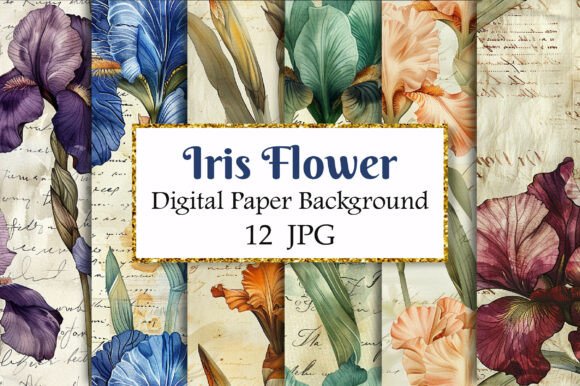
Vintage Iris Flower Digital Paper
Imagine opening a digital folder and finding twelve distinct, softly aged floral patterns—each one centered on the delicate, layered elegance of the iris. These aren’t stock photos or generic clipart. They’re Vintage Iris Flower Digital Paper: high-resolution, thoughtfully designed 12″ × 12″ backgrounds that carry the quiet charm of antique botanical prints, faded ledger paper, and hand-tinted postcards—all preserved in crisp 300 dpi JPEGs.
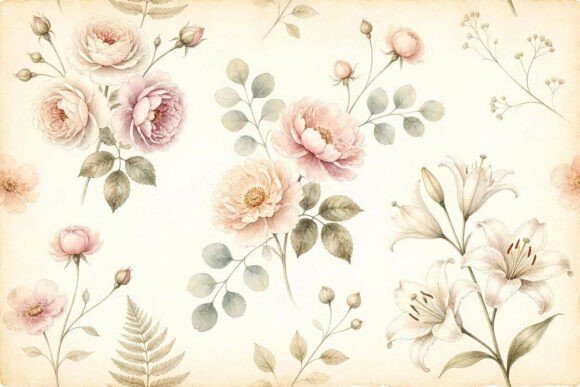
What makes them “vintage” isn’t just the sepia wash or subtle paper texture—it’s the intention behind the design. Petals are slightly asymmetrical. Colors lean into muted lavenders, sage greens, and warm creams rather than saturated neons. Grain is present but never overwhelming. There’s no harsh contrast or digital perfection—just enough character to feel handmade, yet enough clarity to hold up in print or on screen.
Why This Matters—Depending on Who You Are
For crafters and scrapbookers, these papers are ready-to-print layers for memory-keeping. You might cut a border from one pattern to frame a baby’s first photo, or layer two irises at different opacities to build depth in a handmade card. Because they’re JPEGs—not layered PSDs—they open instantly in free tools like Canva or Paint.NET, and scale cleanly in Cricut Design Space or Silhouette Studio. No wrestling with file formats. Just drag, resize, and cut.
Designers and small business owners often need consistent, brand-aligned visuals—fast. A bakery launching a spring collection might use one of the lighter iris papers as a subtle background for product labels, while a yoga studio could overlay a soft quote on a deeper-toned version for an Instagram story. Since each paper is 12″ × 12″ at 300 dpi, it works equally well for letter-sized flyers, A4 invitations, or full-width website headers—no pixelation, no guesswork.
Educators and content creators appreciate subtlety. An elementary art teacher might project one of the patterns during a lesson on botanical illustration, pointing out how the vintage treatment invites observation—not just of shape, but of time, texture, and mood. A blogger writing about mindful gardening could use the same paper as a clean, evocative background for a Pinterest pin, letting the imagery support the message without competing with it.
What Changes Based on Your Goals
If you’re just starting out, your priority is likely accessibility. You don’t want to install plugins, decode licensing jargon, or spend hours adjusting resolution. With Vintage Iris Flower Digital Paper, there’s no subscription, no login wall, and no hidden fees. After purchase, you get an immediate download link—and all twelve files arrive in one ZIP folder. Open it, pick one, and try it in your tool of choice. That low barrier matters when curiosity is your only requirement.
For experienced users, flexibility becomes key. These JPEGs behave predictably across platforms: they import cleanly into Adobe Photoshop for masking and blending, work natively in Affinity Designer for vector-based compositing, and remain editable as raster layers in Procreate (when imported via Files app). Because they’re not watermarked and carry a commercial-use license, you can confidently apply them to client projects—like designing wedding stationery for a local florist or creating printable planner stickers for your Etsy shop.
Hobbyists and home celebrants often care most about emotional resonance. An iris has long symbolized hope, faith, and wisdom—making it especially fitting for birth announcements, milestone birthdays, or sympathy cards. Using a vintage-styled version adds warmth without cliché. It feels personal, not mass-produced—even though it’s digital.
Real Projects, Real Uses
- A freelance invitation designer used the softest lavender paper as a base for foil-stamped wedding suites—scanning a physical sample first to match ink tones, then aligning digital mockups precisely.
- A homeschool parent printed four patterns on sticker paper, cut them into flower-shaped tags with a punch, and used them to label nature journal sections (“Soil,” “Roots,” “Bloom,” “Seed”).
- A café owner added one of the papers as a tiled background to their WordPress site’s “About” page—subtle enough to keep text readable, distinctive enough to reflect their garden-inspired menu.
- A planner enthusiast resized a single pattern to 8.5″ × 11″, printed it on matte cardstock, and punched holes to turn it into a decorative divider page for a bullet journal.
How to Know If It Fits Your Needs
Ask yourself:
- Do I need variety without visual noise? Twelve options give range—some with bolder blooms, others with fine-line sketches or faint watermark-style repeats—but all share a cohesive color palette and era-appropriate restraint.
- Am I working across devices or software? JPEG format means compatibility with everything from Microsoft Word to Figma to mobile design apps. No conversion needed.
- Is print quality non-negotiable? At 300 dpi and 12″ × 12″, these scale down for business cards or up for posters without loss. Test one at 50% size in your layout program—you’ll see how smoothly edges hold.
- Do I value quiet sophistication over trend-driven graphics? These papers won’t shout. They’ll settle into your project like a well-chosen font or thoughtful margin—supporting your message, not defining it.
They’re not meant for every project. If you’re building a high-contrast tech brochure or designing for a neon-lit festival brand, these may feel too gentle. But if your work lives in the space between memory and intention—if you make things that honor slowness, detail, and quiet beauty—then Vintage Iris Flower Digital Paper offers more than decoration. It offers tone. Texture. A shared language of care, visible in every petal.
And because they’re digital-only, there’s no shipping delay, no inventory to manage, and no physical storage. Just twelve moments of calm, ready when inspiration strikes—or when Tuesday afternoon calls for something lovely, simple, and deeply usable.