FREE Sketch Music Notes Icon
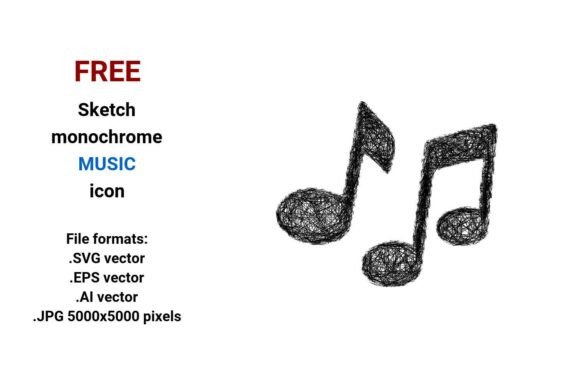
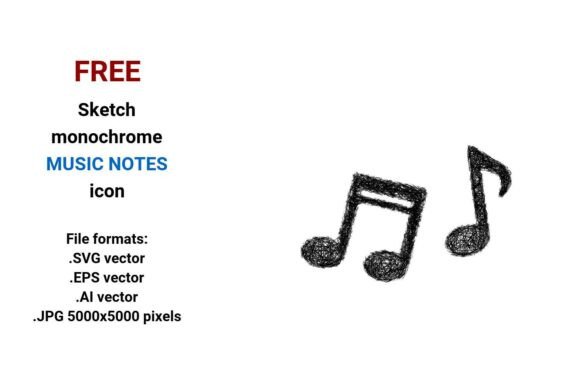
The FREE Sketch Music Notes Icon is a downloadable set of monochrome, hand-drawn music symbols designed for digital use. It includes four file formats: .SVG, .EPS, .AI, and .JPG (5000×5000 pixels). Each version depicts musical notes—such as quarter notes, eighth notes, or stylized note groupings—in a loose, artistic sketch style: rough line art, minimal outlines, and informal hatch-like texture. As a vector image, the .SVG, .EPS, and .AI files scale infinitely without pixelation, while the high-resolution .JPG offers compatibility where vector support is limited.
Why Consider This Icon Set?
Designers, developers, educators, and content creators often seek visual assets that convey musicality without formality. The FREE Sketch Music Notes Icon appeals when you need a human-centered, non-robotic aesthetic—think indie music blogs, music education apps, creative portfolios, or handmade-themed websites. Its sketch quality suggests spontaneity and artistry, distinguishing it from polished, corporate-style icons. Because it’s offered at no cost and includes multiple formats, it lowers entry barriers for small teams or individuals with tight budgets or limited design resources.
Key Benefits
- Format flexibility: Vector files (.SVG, .EPS, .AI) allow editing in illustration software and responsive scaling across devices; the .JPG serves as a ready-to-use raster fallback.
- Design consistency: Monochrome, black-and-white styling ensures legibility on varied backgrounds and easy recoloring via CSS or design tools.
- UI adaptability: Its outline-based, line-art structure works well as a music notes button, navigation symbol, or decorative design element in dashboards, mobile apps, or landing pages.
- Thematic alignment: Terms like handdrawn, freehand sketch icon, and line sketch signal authenticity—valuable for brands emphasizing creativity, learning, or organic expression.
Tradeoffs and Practical Considerations
While useful, the FREE Sketch Music Notes Icon has limitations worth weighing. First, its sketch aesthetic prioritizes expressiveness over precision: curves are intentionally uneven, strokes vary in weight, and negative space may feel less optimized than in professionally kerned icon systems. That makes it less suitable for contexts demanding strict visual hierarchy—like enterprise SaaS interfaces where clarity and speed of recognition outweigh stylistic flair.
Second, the set contains only one core motif: musical notes. It does not include related symbols (e.g., treble clefs, headphones, play buttons) or variations (filled vs. outlined, different note types). Users needing a full music-themed icon library will likely need to supplement this asset.
Third, although the .JPG is high-resolution, it remains a raster image—unsuitable for dynamic resizing in code-driven environments. Relying solely on it risks blurriness on high-DPI screens or when scaled beyond its native dimensions.
When This Icon Fits Well
This resource is a strong fit in several scenarios:
- Educational platforms teaching music theory, where musical notes serve as recurring visual anchors—and a sketch style reinforces learning-as-process rather than rigid correctness.
- Personal or portfolio websites for composers, performers, or sound designers who want to reflect individuality through artistic, informal visuals instead of generic stock icons.
- Mobile or web apps with a light, playful tone—such as lyric journals, practice timers, or music discovery tools—where a modern sketch icon supports an approachable user experience.
- Print or presentation materials requiring scalable, editable assets—for example, workshop handouts or slide decks using music notes icon as section dividers or bullet markers.
When Alternatives May Be Better
Consider other options if your project requires:
- Consistent icon systems: If you’re building a UI with dozens of interactive elements, a cohesive icon family (with matching stroke weights, spacing, and grid alignment) will improve usability more than a single expressive icon—even a high-quality one like this.
- Color integration: While the FREE Sketch Music Notes Icon is monochrome, some projects need multi-tone or gradient-ready assets. In those cases, color-optimized SVGs or icon fonts may offer greater versatility.
- Accessibility-first design: For interfaces where users rely heavily on screen readers or have low vision, highly detailed sketch lines may reduce contrast or legibility at small sizes. Simpler, bolder music notes icon variants—designed to WCAG AA standards—may perform better.
- Commercial licensing clarity: Though labeled “free,” always verify usage rights. Some free assets restrict redistribution or require attribution. If your project involves resale (e.g., a premium theme or template), confirm permissions—or opt for royalty-free marketplaces with explicit commercial terms.
Making a Practical Decision
To determine whether the FREE Sketch Music Notes Icon aligns with your needs, ask three questions:
- Does the sketch aesthetic reinforce—not distract from—your message? If your brand voice is warm, experimental, or learner-focused, yes. If it’s technical, institutional, or minimalist to the point of austerity, consider alternatives.
- Do you need scalability *and* editability? If you’ll resize the icon across breakpoints or adjust stroke width/color programmatically, prioritize the .SVG or .AI versions—and test them in your workflow before committing.
- Is this part of a broader visual language—or a one-off accent? Use it confidently as a standalone music notes button or thematic highlight. But avoid pairing it with mismatched styles (e.g., ultra-thin geometric icons or photorealistic illustrations) unless intentional contrast is part of your design strategy.
In summary, the FREE Sketch Music Notes Icon delivers practical value for specific use cases: accessible, expressive, and format-diverse. It reflects key themes—melody, notes, music, and artistic sketch icon—without overpromising. Its strength lies not in universality, but in intentionality: a tool best applied where human touch matters more than mechanical perfection.