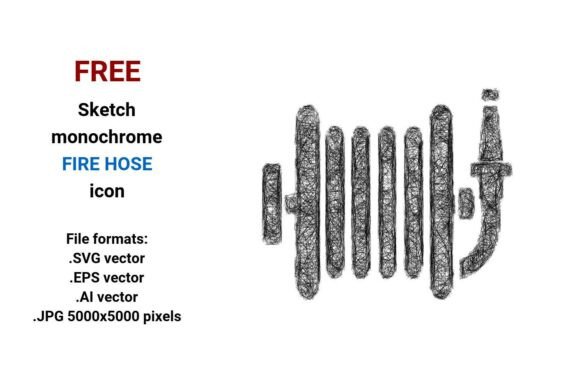
FREE Sketch Fire Hose Icon
The FREE Sketch Fire Hose Icon is a downloadable set of hand-drawn, black-and-white vector and raster graphics depicting a fire hose — rendered in an informal, sketch-style aesthetic. It includes four file formats: .SVG, .EPS, .AI, and .JPG (5000×5000 pixels). Designed for flexibility, it supports both digital and print use cases where a minimal, expressive, or illustrative visual cue is needed — especially around fire safety, emergency response interfaces, or utility dashboards.
Why Consider This Icon?
Designers, developers, and content creators often seek icons that balance recognizability with stylistic cohesion. The FREE Sketch Fire Hose Icon meets this need for projects requiring a less polished, more human-centered visual language — such as internal dashboards, educational materials, safety infographics, or branding elements that emphasize approachability over formality.
Its inclusion of hose reel and fire hose reel as contextual keywords reflects its suitability for applications beyond standalone icons — for example, labeling controls in fire system monitoring software or illustrating water supply infrastructure in technical documentation.
Key Benefits
- Scalable quality: The .SVG, .EPS, and .AI files are true vector images — meaning they retain crisp edges at any size, from small UI buttons to large-format posters.
- Editing flexibility: Vector formats allow users to adjust stroke weight, color, or individual path elements in compatible design tools (e.g., Adobe Illustrator or Figma via SVG import).
- High-resolution raster option: The .JPG file (5000×5000 px) provides pixel clarity for contexts where vector support is limited — such as certain CMS platforms or legacy publishing workflows.
- Consistent style across formats: All versions preserve the same black and white sketch aesthetic — supporting visual continuity in multi-format deliverables.
- No licensing cost: As a free resource, it lowers barriers for low-budget or experimental projects where commercial icon libraries may be cost-prohibitive.
Tradeoffs and Practical Considerations
While the FREE Sketch Fire Hose Icon offers distinct advantages, it also carries limitations worth weighing before integration.
First, its sketchy, handdrawn appearance prioritizes expressiveness over precision. In highly regulated environments — such as official fire department signage or ISO-compliant safety diagrams — standardized, schematic icons may be required for clarity and compliance. This icon’s informal line work and slight irregularity may not meet those thresholds.
Second, the set contains only one composition: a front-facing, coiled or partially uncoiled fire hose, typically shown with a nozzle and sometimes suggestive of a hose reel. It does not include variants — e.g., angled views, action states (e.g., “in use”), or paired elements like hydrants or nozzles alone. Users needing a broader visual vocabulary may need to supplement it with other assets.
Third, while the .JPG file is high-resolution, it is raster-based and therefore not editable in terms of shape or stroke. Adjusting color, line thickness, or proportions requires raster editing — which can degrade quality if scaled beyond original dimensions.
When This Icon Is a Strong Fit
This icon works well in contexts where tone and context outweigh strict standardization:
- Internal dashboards: For fire system monitoring or facility management tools where a fire hose button or hose reel label benefits from visual warmth and quick recognition.
- Educational or awareness materials: Safety training decks, school posters, or community outreach graphics that use sketch clipart to feel accessible and non-intimidating.
- Branding elements: As a subtle design element in logos, app onboarding flows, or web headers where a line fire hose icon reinforces theme without dominating layout.
- Prototyping and wireframing: Its simple, clean, minimal structure makes it suitable for early-stage UI mockups where fidelity is secondary to functionality.
When Alternatives May Be Better
Consider other options if your project requires:
- Regulatory compliance: Official safety documentation, building code illustrations, or public signage often mandate ISO or NFPA-standardized symbols — which tend to be geometric, monochrome, and strictly defined.
- Color integration: Since this icon is black and white, adding consistent brand color requires manual recoloring — a step unnecessary with pre-styled, multi-color icon sets.
- Animation or interactivity: While the SVG version supports basic CSS animation, complex interactions (e.g., hose unwinding) would require custom development — whereas purpose-built animated icon libraries offer plug-and-play solutions.
- System-wide consistency: If you’re building a full icon system (e.g., for a municipal fire department website), a single sketch-style icon may stand out awkwardly among more uniform, professionally curated sets.
Making an Informed Choice
Before downloading or embedding the FREE Sketch Fire Hose Icon, ask yourself:
- What’s the primary function? Is it decorative, instructional, navigational, or regulatory? If the answer leans toward instruction or regulation, verify alignment with relevant standards.
- What tools will you use? If you rely heavily on Figma or Sketch, the .SVG version integrates smoothly; if you need layered AI files for advanced path manipulation, ensure your license permits .AI editing.
- How many related icons do you need? A single fire hose icon rarely exists in isolation. Assess whether companion icons (e.g., hydrant, nozzle, fire truck) exist in the same style — or whether mixing styles introduces visual fragmentation.
- What’s your timeline and skill level? Editing vectors demands familiarity with path tools. If rapid deployment is critical and team members lack vector experience, the .JPG may be faster — though less adaptable long-term.
In summary, the FREE Sketch Fire Hose Icon serves best as a pragmatic, stylistically coherent asset for projects valuing expressiveness, scalability, and accessibility — particularly where formal iconography feels overly rigid. It is not a universal replacement for standardized safety graphics, but rather a thoughtful option within a broader design toolkit. Evaluate it alongside your specific constraints, audience expectations, and implementation environment — not as a standalone solution, but as one component of a deliberate visual strategy.