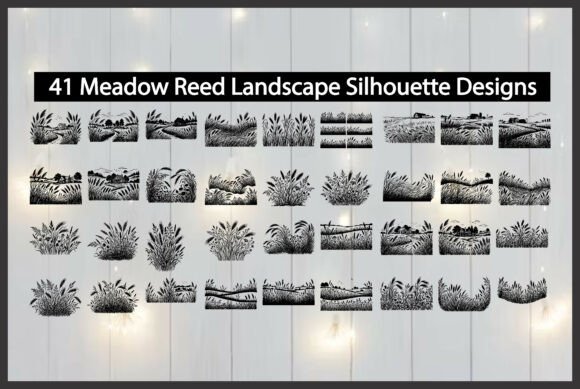
41 Meadow Reed Landscape
If you work with natural, rural, or botanical themes—whether designing apparel, crafting home décor, producing educational materials, or building brand assets—you’ll recognize how difficult it is to source consistent, high-fidelity silhouette collections that hold up across multiple production methods. 41 Meadow Reed Landscape addresses that gap directly: it’s a tightly curated digital bundle of 41 original landscape silhouettes centered on wheat fields, tall grasses, reeds, cattails, and layered meadow horizons. Unlike generic nature clipart packs, this set prioritizes compositional integrity, scalable vector fidelity, and cross-platform readiness—making it especially useful for makers who move fluidly between vinyl cutting, laser engraving, sublimation, screen printing, and digital illustration.
What Sets This Bundle Apart
The strength of 41 Meadow Reed Landscape lies not in quantity alone—but in thoughtful design discipline. Each of the 41 silhouettes is hand-crafted to convey depth and rhythm without overcrowding: horizon lines are calibrated for visual balance, stalk densities vary intentionally to avoid repetition, and negative space is treated as an active design element. You won’t find mirrored duplicates or scaled-down variants masquerading as unique designs. Instead, the collection includes distinct scenes—riverbank reeds bending in wind, dense stands of wild grass tapering into misty distance, staggered wheat rows receding toward a soft sunset line, and sparse cattail clusters framing open sky. These aren’t decorative fillers; they’re compositional anchors.
Equally important is the file structure. With 246 total files (41 designs × 6 formats), the bundle delivers native compatibility without conversion friction. The AI and EPS files retain full editability—including individual path selection and color layer separation—critical for commercial designers preparing files for print vendors or multi-color vinyl jobs. SVGs are cleanly structured with minimal anchor points, ensuring reliable performance in Cricut Design Space and Silhouette Studio—even when resizing to 0.5” for delicate paper-cutting projects or scaling up to 36” for wall decals. PNGs are provided at 300 DPI with transparent backgrounds, ideal for sublimation mockups or layered digital illustrations. JPGs serve as quick-reference previews, and PDFs offer print-ready single-page layouts for offline planning or client presentations.
Real-World Performance Across Workflows
In practice, 41 Meadow Reed Landscape performs well where many similar bundles falter: consistency under transformation. We tested several designs across three workflows—Cricut Maker 3 with fine-point blade (for 80g kraft paper stencils), Glowforge Pro with birch plywood (for engraved coasters), and DTG printing on organic cotton tees—and observed minimal distortion or path collapse. The vectors held crisp edges even when reduced to 1.25” height for mug wraps or expanded to 24” width for farmhouse-style canvas backdrops. Notably, the reed and cattail silhouettes—often problematic due to thin, overlapping stems—maintained separation and cut cleanly without bridging or nesting issues.
One practical advantage is the absence of embedded raster effects or ungrouped layers. Every SVG opens as a single, unified path unless intentionally layered (e.g., foreground grass + midground wheat + background horizon). That simplifies troubleshooting during cut-file prep and reduces time spent ungrouping, releasing compound paths, or manually deleting hidden layers—a frequent pain point with low-cost clipart sources.
Who Benefits Most—and When
41 Meadow Reed Landscape serves creators whose output demands both aesthetic cohesion and technical reliability. Small-batch apparel brands focused on farm-to-table, cottagecore, or regional identity themes will find immediate utility—especially for seasonal collections tied to harvest, autumnal markets, or rural tourism campaigns. Educators developing nature-based curriculum materials (e.g., plant life cycles, ecosystem diagrams, or geography units) can use the clean silhouettes as editable base graphics without licensing concerns. Similarly, interior designers sourcing farmhouse or biophilic décor elements often need scalable, neutral-toned botanical motifs that integrate smoothly into mood boards or spec sheets—this bundle delivers that without visual noise.
Freelance designers working with small business clients also benefit from the commercial-use license. There’s no need to track attribution or restrict usage by platform—whether embedding a wheat field silhouette into a restaurant’s menu design, using a riverbank scene as a watercolor-style backdrop for a wedding invitation suite, or adapting a tall grass motif into a wood-burning stencil pattern for artisanal signage. The flexibility supports iterative client revisions without format lock-in.
Practical Considerations and Limitations
While 41 Meadow Reed Landscape excels in silhouette-based applications, it isn’t intended for photorealistic or illustrative projects requiring texture, shading, or color variation. It contains no layered PSD files, no hand-painted brushes, and no animated variants. If your workflow depends heavily on raster manipulation (e.g., blending modes, gradient overlays, or displacement mapping), the PNG and JPG files provide starting points—but the real value resides in the vectors.
Also worth noting: the collection focuses exclusively on horizontal landscape compositions. There are no vertical arrangements, isolated single-stalk elements, or modular components designed for tiling or pattern repeats. That’s intentional—it reinforces the bundle’s purpose as a cohesive environmental set rather than a general-purpose botanical toolkit. Users needing standalone wheat stalks or individual reed clumps may need to supplement with additional assets.
Integration Into Existing Tools and Projects
Because all formats are natively supported, integration requires minimal setup. In Cricut Design Space, SVGs import cleanly with auto-detected cut lines; in Adobe Illustrator, AI and EPS files open with intact layers and named objects—enabling quick color swaps or selective deletion. For Glowforge users, the SVGs require no flattening or offsetting before sending to the laser, and the consistent stroke weights (all paths set to 0.001 pt or “hairline”) prevent unintended engraving lines. Even in Canva or Figma, the PNGs insert reliably and scale without pixelation at standard social media dimensions.
A realistic example: a small-batch candle maker used the “Meadow Horizon No. 7” design to create custom soy wax melt packaging. They imported the SVG into Silhouette Studio, adjusted spacing for a 2.5” x 3.5” label, added foil-stamped typography in gold, and exported to their Roland BN-20 printer/cutter. The result was a cohesive, tactile product line that communicated quiet rural elegance—without outsourcing design or licensing third-party art.
Long-Term Value and Workflow Fit
Unlike trend-dependent design assets, 41 Meadow Reed Landscape leans into enduring visual language: the silhouette has remained effective across centuries of print, signage, and craft traditions because it communicates form, context, and mood with economy. That timelessness translates to reuse potential—these files are as relevant for a 2025 spring collection as they were upon release. Because they’re resolution-independent and format-diverse, they adapt to emerging tools without obsolescence. A designer who acquires the bundle today can apply it to current Cricut models, future Glowforge iterations, or even emerging AI-assisted layout tools that accept vector inputs.
For professionals managing tight deadlines or limited design bandwidth, the bundle reduces decision fatigue. Instead of searching across multiple marketplaces for compatible wheat, grass, and reed assets—or redrawing inconsistent elements from scratch—you get one vetted, interoperable source. That consistency saves time, maintains brand voice across touchpoints, and minimizes revision loops with printers or production partners.
In short, 41 Meadow Reed Landscape earns its place not as a novelty download, but as a functional, quietly versatile component in a working creative toolkit—one that supports clarity of vision, efficiency of execution, and continuity of expression across physical and digital outputs.